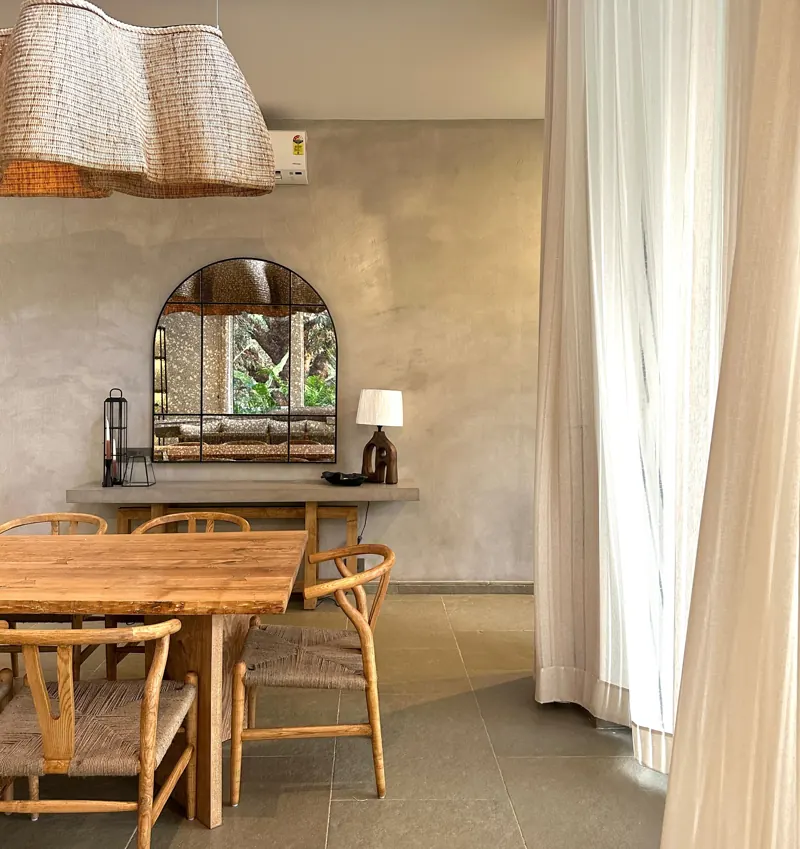
Cement plaster is harder, faster and the default on new Indian buildings. Lime plaster is softer, more flexible and breathable: it lets moisture move through the wall and out, which is why conservation bodies such as SPAB recommend it for older solid masonry and why it is chosen for natural, textured finishes.
Neither is better everywhere. The right choice depends on the wall, how much moisture it has to handle, and the finish you want.
How Does Each One Set?
Cement plaster sets by hydration: it reacts with water and gains strength within days. Lime plaster hardens mainly by carbonation, slowly absorbing carbon dioxide from the air and turning back into a limestone-like material over weeks and months. That slow set is why lime work needs more time, skilled hands and protection from drying out too fast, which matters in Delhi's hot, dry months (see wall finishes for Delhi's climate).
Comparison Table
| Factor | Lime plaster | Cement plaster |
|---|---|---|
| Sets by | Carbonation, slowly | Hydration, quickly |
| Hardness | Softer | Harder |
| Flexibility | Accommodates small movement | Rigid; prone to cracking with movement |
| Breathability | High (vapour-permeable) | Low |
| Moisture in solid walls | Lets it evaporate | Can trap it behind the plaster |
| Compatibility with old brick and stone | Good | Can damage soft masonry |
| Working time | Slower; needs curing care | Faster |
| Skill needed | Specialist | Widely available |
| Finish | Natural, smooth, rough or textured | Usually a base for paint or putty |
| Repairs | Easy to resurface and patch in lime | Patches can show; hard to remove |
Breathability and Damp
Lime plaster is vapour-permeable, so moisture that gets into a wall can dry out through it. Cement plaster is much less permeable. On older solid brick or stone walls, SPAB and Historic England warn that cement renders can crack, let water in and trap it in the wall, where it causes decay. Lime will not stop a leak or rising damp at its source. The next section explains what it can and cannot do on a damp wall.
Lime Plaster on Damp Walls: What It Can and Cannot Do
Lime plaster helps damp walls dry, but it does not stop water getting in. Common sources of damp in Indian homes are:
- roof and terrace seepage;
- leaking bathroom and kitchen pipes;
- monsoon rain soaking exposed walls;
- ground moisture rising into walls without a working damp-proof course;
- condensation in poorly ventilated rooms.
When a damp wall is covered in cement plaster and plastic emulsion, moisture collects behind them, and paint blisters, putty powders and salts bloom. Lime is not waterproofing. It will not hold back a terrace leak or stop rising damp on its own, and plastering over a live leak only moves the problem.
| Step | What to do | Why |
|---|---|---|
| 1 | Find and fix the water source (leak, drainage, roof, pipes) | Nothing lasts on a wall that keeps getting wet |
| 2 | Remove impermeable layers in the damp area (cement plaster, plastic emulsion, waterproof putty) | They trap moisture |
| 3 | Let the wall dry as far as possible, with ventilation | Lime needs a wall that can dry |
| 4 | Brush off dry salts (efflorescence) | Salts keep drawing moisture |
| 5 | Apply lime plaster | Lets residual moisture escape |
| 6 | Finish with a breathable coating such as limewash, or leave the lime as the finish | A plastic paint on top undoes the benefit |
White, powdery salts are left behind as moisture evaporates. Brush them off dry rather than washing them back in; if they keep returning, water is still getting in. Lime is naturally alkaline, which discourages mould, and a breathable wall dries faster, but bathrooms and closed rooms still need ventilation in the monsoon. For limewash in wet conditions, see is limewash waterproof.
Strength and Cracking
Cement is stronger in compression, which suits new frame structures and areas that take knocks. Its rigidity, though, means it cracks when a building moves. Lime is softer and more flexible, so it copes better with small movement. That flexibility is also why lime is matched to soft old masonry: the plaster should not be harder than the wall.
Finish and Look
Cement plaster is usually a base that is then puttied and painted. Lime plaster can be the finish itself. Colortale's lime plaster comes in smooth, rough and textured decorative finishes, is made with low VOC products, has an antibacterial finish, and offers hassle-free resurfacing. Colortale offers it in a range of colours; ask for samples to see the options. For lime plaster indoors, see lime plaster for interior walls. For the difference between a lime plaster and a lime paint, read lime wash vs lime plaster.
Which Is Better for Exterior Walls?
On old solid masonry, lime: it lets walls breathe and weathers gently. On new cement-plastered buildings, cement remains the usual base, and a breathable decorative finish can go on top. For a polished lime look on humid exteriors, Colortale offers Venetian Facade, a hydraulic lime plaster designed for exteriors with protection against mould and algae. Colortale also describes its lime plaster as suitable for exterior walls and damp-prone surfaces (lime plaster).
What About Gypsum Plaster?
Gypsum is a fast, smooth interior plaster. It does not suit damp areas or exteriors because it softens when wet. Lime is breathable and tolerates moisture better; cement is the hard, external-grade option.
Lime Plaster or Microcement?
If you are weighing lime plaster against microcement, the choice is breathability against a sealed surface: lime plaster is natural and breathable, while microcement is seamless and waterproof when sealed. See microcement vs other wall finishes.
Cost: What Drives It?
Cost depends mostly on labour and scope. Lime work is slower and needs specialist applicators, and a decorative lime plaster is also the finish, so the material is only part of the price. A fair comparison is a cement plaster with putty and paint against a lime plaster that is the finish itself. Ask for written quotes that show preparation, coats and finish.
Lime or Cement: The Short Answer
Choose cement plaster for fast, hard base coats on new construction. Choose lime plaster for breathable walls, older solid masonry and a natural finish that needs no paint. Contact us for a site assessment.
Frequently Asked Questions About Lime Plaster vs Cement Plaster
What is the main difference between lime plaster and cement plaster?
Lime plaster is softer, flexible and breathable, and sets slowly. Cement plaster is harder, rigid and less permeable, and sets quickly.
Is lime plaster better than cement plaster?
For breathable walls, old masonry and natural finishes, yes. For fast, hard base coats on new buildings, cement is the usual choice.
Does lime plaster crack less than cement?
Lime is more flexible and copes better with small movement. Rigid cement plaster is more prone to cracking when a building moves.
Is lime plaster good for damp walls?
Yes, once the water source is fixed. It lets moisture evaporate instead of trapping it, but it is not waterproofing and does not stop leaks or rising damp.
Can lime plaster be used on exterior walls?
Yes, especially on older solid masonry. Colortale's Venetian Facade is a hydraulic lime plaster designed for humid exteriors.
Is lime plaster more expensive than cement plaster?
It depends on the scope. Lime work is slower and specialist, but it can replace putty and paint. Compare written quotes.
Lime plaster vs gypsum: which is better?
Gypsum is fast and smooth for dry interiors. Lime is breathable and handles moisture better.
Should I remove cement plaster from a damp wall?
In the damp area, often yes, because cement plaster can trap moisture behind it. Get the wall assessed first.
What colours and textures does lime plaster come in?
Colortale's lime plaster comes in smooth, rough and textured finishes in a range of colours. Ask for samples to compare them in your light.
Does lime plaster need painting?
No. Lime plaster can be the finished surface, in smooth, rough or textured effects. If you do coat it, use a breathable finish such as limewash, not plastic emulsion.