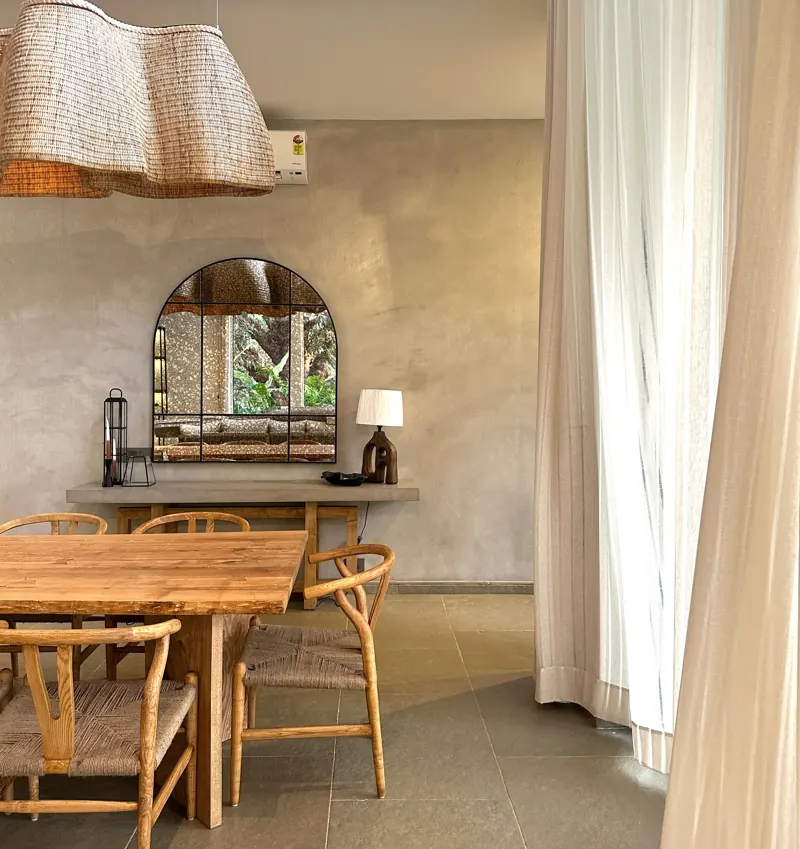
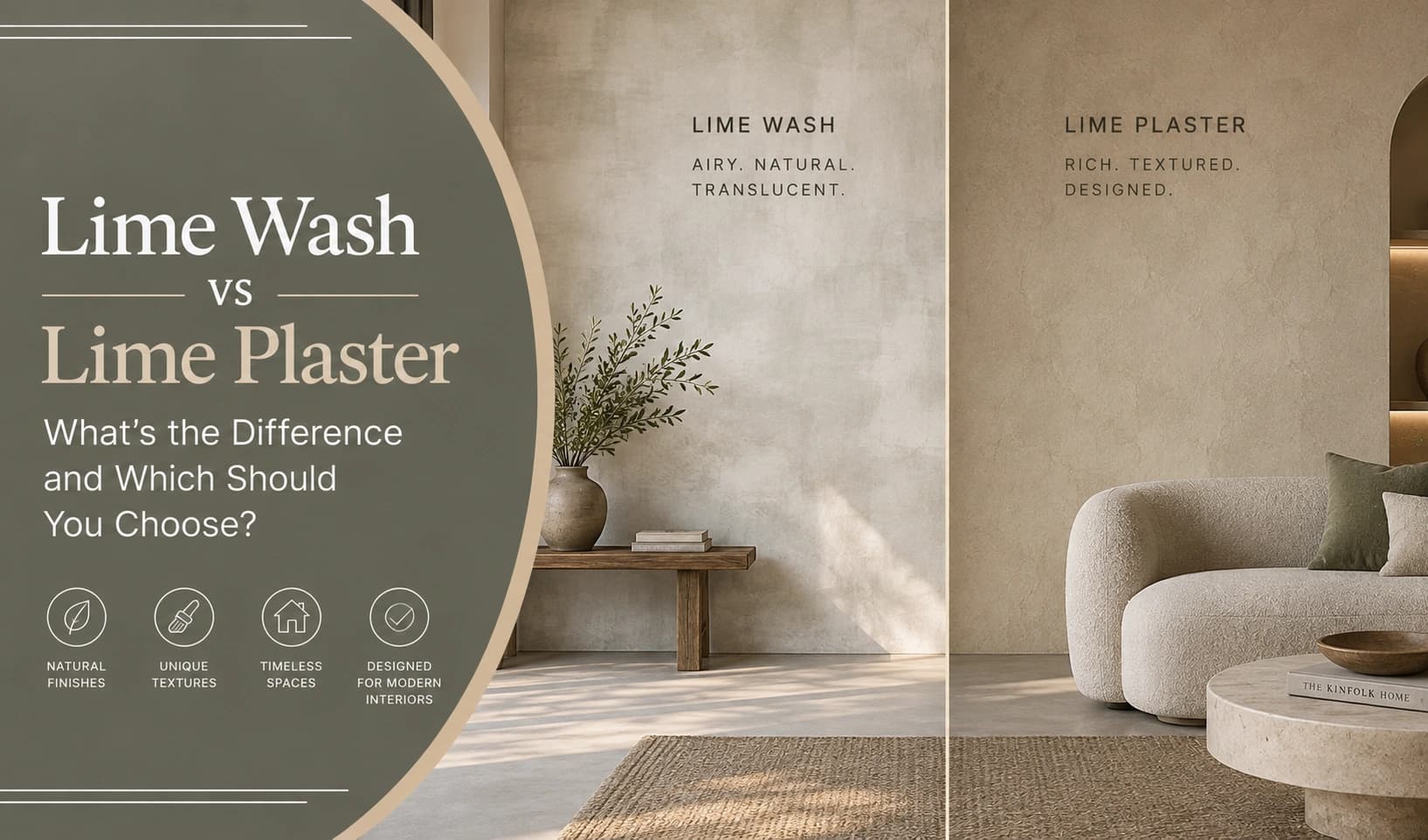
At first glance, lime wash and lime plaster can look surprisingly similar.
Both can create soft, mineral surfaces. Both are associated with natural tonal variation rather than perfectly flat colour. And both are increasingly considered by architects, interior designers and homeowners looking for walls with more character than a conventional painted surface.
But lime wash and lime plaster are not the same finish.
They differ in how they are applied, how much material depth they create, how they interact with the substrate, the kind of texture they can achieve, the craftsmanship involved and the role they play in an interior.
That distinction matters.
Choosing between them based only on a photograph can lead to the wrong material being specified for the intended design.
The better question is:
What do you want the wall itself to contribute to the space?
If you want a light, softly varied mineral coating that keeps the character of the underlying wall relatively visible, lime wash may be the better direction.
If you want the wall to develop greater material depth, texture and a more deliberately crafted architectural surface, lime plaster may be more appropriate.
Neither is universally better.
The right choice depends on the surface, design intent, project conditions and the type of finish you want to experience every day.
Lime Wash vs Lime Plaster: Quick Comparison
| Consideration | Lime Wash | Lime Plaster |
|---|---|---|
| Material role | Thin decorative mineral coating | Trowel-applied decorative plaster finish |
| Visual character | Soft, cloudy, matte and tonal | Mineral, tactile and more dimensional |
| Texture | Generally subtle | Can range from smooth to strongly textured |
| Application | Commonly brush-applied | Commonly trowel-applied |
| Material depth | Relatively light | More substantial surface build |
| Craft influence | Brush movement affects character | Trowel technique strongly influences character |
| Best considered when | You want gentle variation without a heavily built surface | You want the surface itself to become an architectural feature |
| Surface preparation | Important | Equally important |
| Moisture suitability | Depends on product, substrate and exposure | Depends on system, substrate and exposure |
| Waterproof? | Should not be assumed | Should not be assumed |
| Final selection | Based on substrate, colour, lighting and desired variation | Based on substrate, texture, application, lighting and desired variation |
The most important takeaway is simple:
Lime wash behaves more like a decorative coating. Lime plaster behaves more like a decorative surface material.
That difference influences almost everything that follows.
What Is Lime Wash?
Lime wash is a lime-based coating traditionally made using lime and water, often with compatible pigments added to create colour.
Contemporary systems can vary in formulation, so products carrying the name “lime wash” should not automatically be assumed to have identical properties.
Visually, lime wash is valued for its softness.
Instead of creating the perfectly uniform appearance associated with many conventional paints, lime wash can produce gentle tonal movement across the wall. Brush application, surface absorption, pigment and lighting can all influence how that variation appears.
The result can feel quiet rather than decorative in an obvious way.
A neutral lime-washed wall may look almost understated from a distance, yet change subtly as daylight travels across the room.
That is part of its appeal.
Rather than covering a wall with a visually dominant texture, lime wash can introduce atmosphere through variation.
What Is Lime Plaster?
Lime plaster is a plaster finish in which lime acts as a principal binder.
Depending on the particular system, it may contain aggregates, mineral components, pigments and other compatible ingredients that influence its application and appearance.
Unlike lime wash, which is typically applied as a relatively thin coating, lime plaster is worked onto the surface with a trowel to create a more substantial material finish.
This gives the applicator considerably more control over the character of the wall.
A lime plaster finish may be developed to appear:
- extremely smooth and restrained,
- softly clouded,
- visibly trowelled,
- earthy and textured,
- lightly polished,
- or deliberately artisanal.
This does not mean every lime plaster wall should look rustic.
One of the strengths of contemporary lime plaster is that it can work equally well in minimal, modern and luxury interiors when the texture and colour are appropriately developed.
You may learn more about Lime Plaster for Interior Walls.
The Biggest Difference Is Material Depth
Colour alone does not explain the difference between lime wash and lime plaster.
Material depth does.
Lime wash works primarily with the appearance of the existing surface.
It introduces colour and tonal movement without necessarily transforming the wall into a heavily textured material element.
Lime plaster provides greater opportunity to build the character of the visible surface itself.
This is why the two finishes can create very different experiences even when similar colours are selected.
Imagine two warm beige walls.
The lime-washed wall may reveal soft brush movement and cloud-like variation.
The lime-plastered wall may have subtle trowel movement, greater tactile depth and small changes in texture that become increasingly visible as light moves across it.
The colour may be similar.
The architectural experience is not.
Lime Wash vs Lime Plaster for Texture
If texture is an important part of the interior concept, this distinction becomes particularly relevant.
Lime Wash
Lime wash generally produces a lighter visual texture.
Its character is created through brush movement, transparency, pigment variation and the way the coating interacts with the surface below.
The wall can still feel highly distinctive, but the effect is usually created through tonal variation rather than pronounced physical relief.
Lime Plaster
Lime plaster offers much greater control over physical surface character.
Depending on the system and technique, it can be developed into smooth, softly textured or highly expressive finishes.
For architects, this makes lime plaster particularly interesting when the wall itself needs to contribute to the material palette alongside timber, natural stone, metal, fabric or other architectural surfaces.
Which Finish Looks More Luxurious?
Luxury is the wrong way to separate these materials.
Either finish can work in a premium interior when it is specified and executed well.
A beautifully executed lime wash can be far more sophisticated than an unnecessarily elaborate plaster finish.
Likewise, a restrained lime plaster surface can create enormous depth without appearing decorative or excessive.
The better distinction is:
What kind of luxury is the project trying to create?
If the design calls for softness, restraint and a lightly aged mineral character, lime wash can work beautifully.
If the intention is craftsmanship, tactile richness and a surface with greater architectural presence, lime plaster may make more sense.
Modern luxury is often less about ornament and more about the quality of material, proportion, light and execution.
Both finishes can participate in that language.
Application: Brush vs Trowel Changes the Result
Application technique is fundamental to the final appearance.
Lime wash is commonly applied using brushes in successive coats according to the requirements of the selected system.
The movement of the brush contributes to its characteristic variation.
Lime plaster is generally applied and developed with trowels or specialist plastering tools.
The applicator can influence texture, movement, transitions and the way the surface reflects light.
This is why craftsmanship should not be treated as something separate from the material.
For artisanal finishes, the hand of the applicator becomes part of the finished design.
Two contractors using a similar material can create visibly different results if their preparation and application techniques differ.
For important projects, physical samples—and where appropriate, larger mock-ups—are considerably more useful than choosing from photographs alone.
Substrate Preparation Matters for Both
A premium finish cannot compensate for a problematic substrate.
Before either lime wash or lime plaster is selected, the existing wall should be evaluated.
Questions may include:
- Is the surface stable?
- Are there cracks?
- Is existing paint firmly bonded?
- Is the wall excessively absorbent?
- Is moisture present?
- Has the substrate been repaired using different materials?
- Are previous coatings compatible with the proposed finish?
A decorative surface should never be expected to solve an unresolved construction problem underneath it.
This is particularly important during renovation.
An existing painted wall, cement plaster, board surface, masonry wall or previously finished surface may each require a different preparation strategy.
The correct approach depends on the complete material system rather than the name of the decorative finish alone.
Lime Wash vs Lime Plaster on Existing Painted Walls
A common renovation question is whether these finishes can simply be applied over existing paint.
There is no responsible universal answer.
Existing paint first needs to be assessed for adhesion, type, condition and compatibility with the proposed system.
A wall covered in weak, flaking or incompatible coating does not become a reliable substrate simply because a premium finish is applied over it.
Preparation could involve cleaning, removal of unstable coatings, repair, levelling or use of compatible primers/base systems depending on the specification.
The decision should therefore start with an assessment of the wall—not with the decorative finish.
How Lighting Changes Lime Finishes
Lighting is particularly important with both lime wash and lime plaster because neither needs to behave like a perfectly flat colour.
Natural daylight can make tonal movement much more visible at certain times of the day.
Grazing light can reveal brush or trowel movement.
Warm artificial light may intensify earthy tones.
Diffuse lighting can make stronger texture appear visually softer.
This means a finish selected under showroom lighting may appear different in the final room.
Whenever possible, samples should be viewed in the actual project environment alongside flooring, timber, fabrics, stone, cabinetry and the intended lighting.
For larger surfaces, a small colour sample may still not tell the entire story.
A larger mock-up can demonstrate how variation behaves across a realistic wall area.
Which Is Better for Living Rooms?
Both can work.
Choose based on the role of the walls within the design.
Lime wash can be particularly effective when the living room already contains strong architectural elements, artwork, furniture or natural materials and the walls need to remain quiet while still having character.
Lime plaster can become more important when the walls themselves form a central part of the material concept.
Large uninterrupted surfaces, double-height spaces, feature walls and minimal rooms can benefit from the additional depth a plaster finish can create.
The choice should not be based simply on which one looks more expensive.
It should be based on which material expression belongs in the room.
Which Is Better for Bedrooms?
Bedrooms often benefit from restrained materials.
A softly varied lime wash can create visual warmth without making the wall overly dominant.
Lime plaster can also work extremely well, particularly where a smooth or lightly textured finish is used to create depth behind a bed, around architectural elements or across an entire room.
Colour, artificial lighting and tactile character become especially important here.
The objective should usually be coherence rather than maximum texture.
What About Offices, Hotels, Cafés and Retail Spaces?
Commercial and hospitality interiors introduce another consideration: identity.
A specialist finish can become part of how people remember a space.
For example, ColorTale's Faridabad Office uses limewash across the walls and ceiling alongside Pastellone flooring. Rather than treating the walls as neutral background paint, the limewash contributes softness, tonal movement and material continuity to the workspace.
In hospitality and retail environments, this type of material decision can help establish an atmosphere without relying on excessive graphics or decoration.
Lime plaster can perform a similar role but with greater material presence.
The right choice depends on whether the design requires quiet tonal variation or a more tactile architectural surface.
Can Lime Wash or Lime Plaster Be Used in Bathrooms?
This question requires more care than many online comparisons suggest.
Breathable does not mean waterproof.
Lime-based materials can have useful vapour-transfer characteristics depending on their formulation, but that does not automatically make every lime finish suitable for direct water exposure.
A powder-room wall, a bathroom wall away from a shower and the inside of a continuously wet shower enclosure are very different conditions.
For bathrooms, specification should consider:
the exact product system, substrate, waterproofing, ventilation, expected water exposure, joints and penetrations, protective treatments where required, and manufacturer or applicator guidance.
Do not choose a bathroom finish solely because someone describes it as “natural” or “breathable.”
The complete construction system matters.
Which Finish Is Easier to Maintain?
There is no useful universal rule that one requires no maintenance while the other requires constant maintenance.
Actual maintenance depends on the selected system, surface treatment, colour, texture, level of contact and how the room is used.
A highly touched commercial corridor experiences different conditions from a bedroom feature wall.
Likewise, stains may behave differently on a deeply textured surface than on a smoother one.
Before selecting either finish, ask how the specific surface should be cleaned and how future repairs will be handled.
With handcrafted finishes, repairs may not always become completely invisible.
That should be understood during specification rather than discovered after damage occurs.
Which Is More Expensive: Lime Wash or Lime Plaster?
Lime plaster will often involve a more substantial application process and greater craft input than lime wash, but giving a universal price difference would be misleading.
Final project cost can be affected by:
surface condition, preparation requirements, selected finish, number of coats or application stages, colour and texture complexity, size of the area, access, project location, protection requirements and the level of craftsmanship involved.
A low-cost quotation over a poor substrate can become more expensive later if preparation has been underestimated.
The better comparison is therefore between complete project specifications—not just the price of the visible material.
Lime Wash or Lime Plaster: How Should You Decide?
Choose lime wash when you want the wall to feel soft, mineral and subtly varied without making physical texture the domine2ant feature.
It is particularly compelling when the interior needs:
gentle tonal variation, a matte mineral character, visual softness, a lighter decorative intervention, or a backdrop that interacts quietly with natural materials and light.
Choose lime plaster when the surface itself needs greater depth and architectural presence.
It becomes particularly relevant when the design calls for:
tactile material character, controlled trowel movement, more substantial texture, highly customised surface expression, or walls that function as important architectural elements rather than simple backgrounds.
If you are still choosing based only on photographs, the project is probably not ready for final material selection.
Review physical samples.
Look at them under actual lighting.
Compare them with the other materials in the project.
And understand how the intended substrate will be prepared.
Can Lime Wash and Lime Plaster Be Used in the Same Project?
Yes—if the overall material strategy supports it.
There is no requirement for an entire project to use one decorative wall finish.
A designer may choose a quieter lime wash across larger wall areas while introducing lime plaster where additional depth or emphasis is required.
However, they should not automatically be layered over one another without confirming compatibility.
Using different finishes successfully is a design and technical decision, not simply a decorative one.
Colour relationships, transitions, substrates and the degree of visible variation should all be coordinated.
What Architects and Designers Should Specify
For professional projects, writing “lime finish” on a drawing is not enough.
The specification should identify the selected system and establish the intended:
substrate condition, preparation, colour, texture, sheen, degree of variation, application area, interface with adjoining materials, treatment of corners and edges, sample approval process and maintenance expectations.
For handcrafted surfaces, defining acceptable variation is particularly important.
The objective is not necessarily to make every square metre identical.
The objective is to establish a consistent visual language in which variation feels deliberate.
Final Verdict: Lime Wash vs Lime Plaster
There is no single winner.
Lime wash is the better choice when you want a lighter, softly varied mineral coating.
Lime plaster is the better choice when you want greater tactile depth and a more substantial architectural surface.
Both can create sophisticated walls.
Both depend on appropriate substrates and skilled execution.
And neither should be chosen solely because a photograph on a mood board looks attractive.
The right finish is the one that responds to the architecture, the surface underneath it, the way the room will be used and the material character the project is trying to achieve.
At ColorTale, lime-based finishes can be developed around different colours, textures and applications to suit residential, hospitality, retail and commercial spaces.
If you are deciding between Lime Wash and Lime Plaster, reviewing physical samples and discussing the actual substrate before final selection can help establish the right direction for your project.