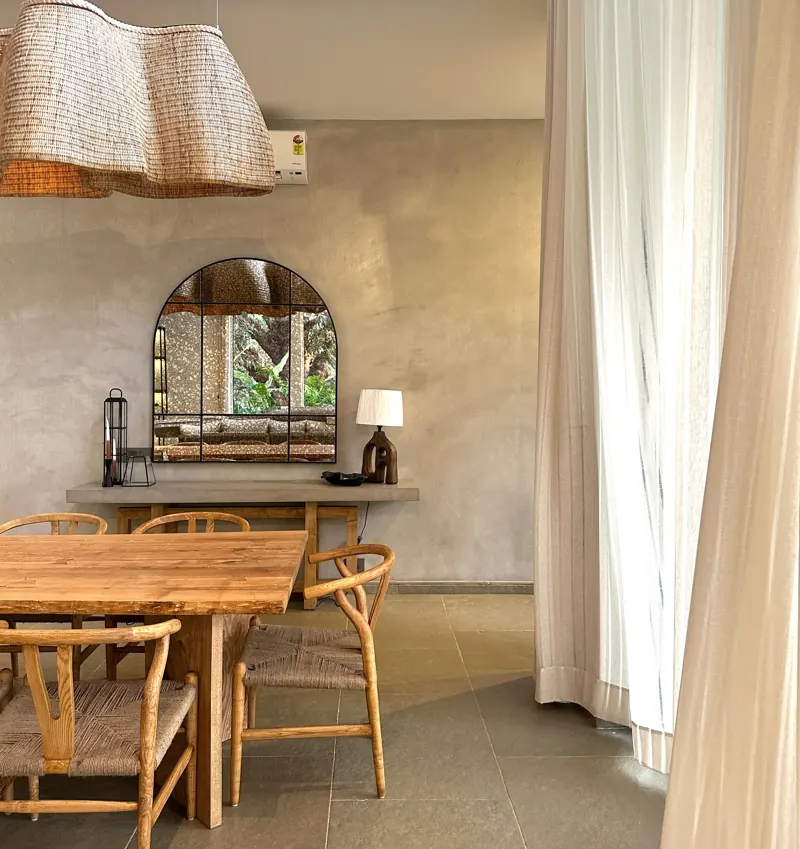
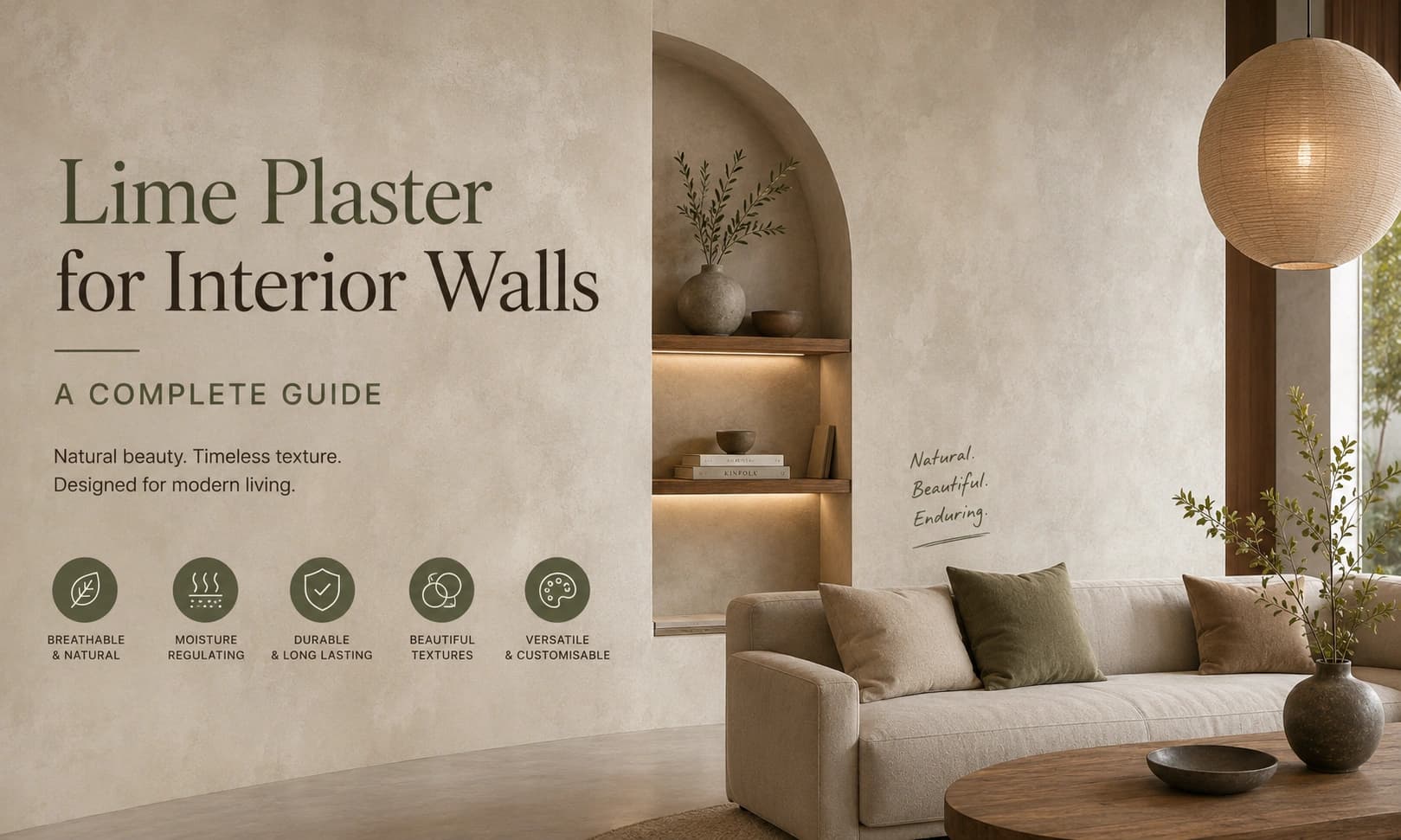
Interior walls are no longer treated simply as backgrounds for furniture, artwork and decoration. In contemporary architecture, the wall itself can become a material element—one that introduces texture, depth, softness and a sense of craftsmanship into the space.
This is one reason lime plaster for interior walls has attracted renewed interest among architects, interior designers and homeowners. Although lime-based plaster has a long history in architecture, contemporary applications allow its mineral character to work beautifully with minimalist, modern and luxury interiors.
Unlike a conventional painted wall, lime plaster can create subtle tonal movement and tactile depth across a surface. Depending on its formulation and application technique, it can appear smooth and understated or visibly textured and artisanal.
But choosing lime plaster should involve more than liking its appearance. The substrate, moisture conditions, application method, lighting, desired texture and maintenance expectations all influence whether it is the right surface for a particular project.
This guide explores what lime plaster is, how it works on interior walls, where it can be used, what it looks like, how it compares with other finishes and what architects and designers should consider before specifying it.
What Is Lime Plaster?
Lime plaster is a plastering material in which lime acts as a principal binder. It can contain aggregates and other compatible ingredients depending on the formulation and the intended application.
Lime has been used in architecture for centuries, particularly because of its workable nature and its ability to form mineral-based wall surfaces. Contemporary decorative lime plaster builds on this material language while offering a broader range of textures, colours and visual effects for modern interiors.
It is important, however, not to treat every product described as “lime plaster” as the same material.
Traditional lime plaster used for construction or heritage restoration can have different formulations and performance characteristics from a contemporary decorative lime plaster designed primarily as a visible interior surface. The application system, substrate requirements and finishing techniques can therefore vary considerably.
What Gives Lime Plaster Its Distinctive Appearance?
The character of a lime plaster wall comes from the interaction of material and craftsmanship. Depending on the system, the finished surface can display:
- subtle tonal variation
- mineral depth
- soft texture
- trowelled movement
- matte or lightly polished character
- gentle imperfections
- changes in appearance as light moves across the wall
The result does not necessarily look “rough.” A well-executed lime plaster finish can be extremely refined, with its visual interest coming from depth and variation rather than pronounced texture.
That makes it particularly relevant to contemporary interiors where the objective is often to create atmosphere without adding visual clutter.
Why Is Lime Plaster Becoming Popular in Modern Interiors?
Modern interior design has increasingly moved towards material-led spaces.
Instead of relying exclusively on colour, pattern and decorative objects, designers are using the inherent qualities of materials to establish mood. Natural stone, timber, metal, textured fabrics and mineral surfaces can all contribute to the sensory character of a room.
Lime plaster fits naturally into this approach.
A wall finished in lime plaster can provide visual variation without introducing a printed pattern. It can soften the geometry of a minimalist room, complement natural materials and create a handcrafted quality that a perfectly uniform surface may not provide.
This is particularly effective in spaces where restraint is part of the design language.
A quiet neutral room, for example, may gain considerably more depth from a softly varied mineral wall than from another layer of perfectly flat paint.
The appeal is therefore not simply that lime plaster is “natural” or “traditional.”
Its contemporary relevance lies in its ability to make the surface itself part of the design.
What Does Lime Plaster Look Like on Interior Walls?
There is no single lime plaster appearance.
The final result depends on the material formulation, aggregate, pigment, application technique, number of coats, tools, finishing process and desired degree of variation.
Smooth Lime Plaster
A smooth finish can create a sophisticated wall with very subtle material movement. Rather than obvious texture, the eye notices changes in tone and the way light moves across the surface.
This works particularly well in minimalist bedrooms, living spaces and contemporary architectural interiors.
Textured Lime Plaster
A more tactile finish makes the surface itself more prominent.
Depending on the technique, texture can range from delicate irregularity to a strongly articulated surface. This approach can work well for feature walls, hospitality spaces and interiors where material expression is an important part of the design.
Clouded and Tonal Finishes
Subtle variations in colour and application can produce a clouded appearance, where the wall seems to have depth rather than a single flat colour.
This can be particularly effective with earthy, mineral and muted tones.
Naturally Imperfect Finishes
One of the defining attractions of handcrafted plaster is controlled variation.
A handmade surface does not necessarily need to look identical at every point. Slight differences in movement, texture and tone can create visual richness.
The important distinction is between intentional variation and uncontrolled inconsistency.
For a premium architectural finish, the goal should be a surface where variation feels deliberate and coherent with the design.
Lime Plaster vs Conventional Wall Paint
Lime plaster and conventional paint serve different design purposes.
| Consideration | Lime Plaster | Conventional Paint |
|---|---|---|
| Visual character | Mineral, tactile and subtly varied | Generally uniform |
| Surface depth | Can create perceptible material depth | Usually limited |
| Texture | Can range from smooth to highly textured | Usually flatter |
| Customisation | Colour, texture and application character | Primarily colour and sheen |
| Craftsmanship | Strongly influences final appearance | Usually less visually dominant |
| Design role | Can become a feature of the architecture | Often functions as a background |
| Application | Generally more specialised | Usually simpler |
This does not make lime plaster universally better than paint.
Paint remains one of the most versatile and practical wall finishes available. Lime plaster becomes compelling when the design calls for materiality, texture, tonal variation and craftsmanship rather than simply a uniform colour.
Lime Plaster vs Cement Plaster
Lime plaster and cement plaster can both be used in wall construction, but they should not be considered interchangeable.
Cement-based plaster is widely used as a construction and base-plaster material, while decorative lime plaster is often selected for the character of the visible surface.
Their differences can involve binder chemistry, texture, workability, moisture-vapour behaviour, substrate compatibility, application and intended use.
For interior design, the more useful question is not whether one material is universally superior. It is whether the selected plaster system is appropriate for the substrate and the desired finished surface.
A wall may also use a cement-based substrate or base layer before receiving a decorative surface finish. The compatibility of the complete system is therefore more important than comparing individual materials in isolation.
A dedicated Lime Plaster vs Cement Plaster guide can explore these differences in greater technical depth.
Is Lime Plaster Suitable for Modern Interior Design?
Yes—when its material character aligns with the design intent.
Minimalist Interiors
Minimalism depends heavily on proportion, light, texture and material quality. A softly varied lime plaster wall can introduce depth without disrupting a restrained aesthetic.
Instead of adding another decorative element, the wall becomes the decorative element.
Japandi and Natural Interiors
Lime plaster pairs naturally with materials such as timber, stone, linen and other tactile finishes. Its mineral appearance can complement the muted palette and natural material vocabulary commonly associated with these interiors.
Contemporary Luxury Homes
Luxury does not necessarily require gloss, ornament or highly elaborate decoration.
In contemporary homes, craftsmanship and material authenticity can create a more understated form of luxury. A carefully developed lime plaster surface can contribute to this aesthetic by giving large wall planes their own character.
Mediterranean-Inspired Spaces
Lime-based finishes have strong historical associations with Mediterranean architecture, but contemporary applications do not need to replicate traditional interiors.
The material can instead be interpreted through cleaner geometry, restrained colours and modern furniture.
Boutique Hospitality and Retail
In hospitality and retail environments, surfaces contribute to atmosphere and identity.
A distinctive lime plaster wall can help establish a tactile visual language that feels more considered than a generic painted surface.
Where Can Lime Plaster Be Used on Interior Walls?
The versatility of lime plaster comes partly from the fact that walls themselves can play different roles within a space.
In living rooms, it can create a large feature surface behind furniture, artwork or other architectural elements.
In bedrooms, softer textures and restrained colours can create a calm material backdrop.
In dining areas, lime plaster can interact particularly well with warm artificial lighting and natural materials.
In entrances and corridors, it can establish continuity and give otherwise transitional spaces a stronger architectural identity.
In restaurants, hotels and retail environments, it can contribute to a distinctive atmosphere and provide a tactile surface that customers experience as part of the space.
However, application suitability should always be considered alongside substrate condition, impact exposure, moisture and the specific characteristics of the selected finish.
Can Lime Plaster Be Used in Indian Homes?
Lime plaster can be highly relevant to Indian interiors, but its suitability should not be determined by climate alone.
India encompasses a wide range of environmental conditions—from humid coastal regions and monsoon-heavy areas to hot and comparatively dry climates.
Interior conditions can also vary significantly depending on ventilation, air conditioning, building construction and the location of the wall.
For this reason, specifying lime plaster for an Indian project requires consideration of the specific formulation, substrate, room conditions, moisture exposure and application system.
This is particularly important in areas where humidity or water exposure is high.
The idea that “lime plaster is breathable, therefore it works everywhere” is too simplistic. Breathability, moisture resistance and waterproofing are different concepts, and each needs to be considered independently.
Is Lime Plaster Breathable?
The term “breathable” is frequently used when discussing lime-based materials, but it needs to be understood correctly.
In building-material terms, breathability generally relates to the movement of water vapour through a material rather than the ability to prevent liquid water from entering it.
That means:
Vapour permeability is not the same as waterproofing.
A lime-based finish may have useful vapour-transfer characteristics, but that does not automatically make it appropriate for direct water exposure or eliminate the need for appropriate waterproofing and moisture-management systems.
For architects, this distinction is particularly important when specifying finishes for bathrooms, kitchens, basements or humid environments.
Is Lime Plaster Suitable for Bathrooms and Wet Areas?
There is no universal yes or no.
Suitability depends on the specific lime plaster system, the substrate, the degree of water exposure, waterproofing strategy, detailing, ventilation and the requirements of the manufacturer or applicator.
A decorative lime plaster finish on a bathroom wall outside a direct shower zone presents a different condition from a surface receiving continuous direct water exposure.
For wet areas, the entire construction system needs to be considered rather than relying on the decorative finish alone.
Where direct water exposure is expected, the appropriate waterproofing and substrate system should be established first.
What Surfaces Can Lime Plaster Be Applied To?
The answer depends on the specific lime plaster system and the condition of the substrate.
Plastered Walls
A sound and stable plastered wall can provide a suitable foundation when appropriately prepared.
Weak areas, cracks, contamination and incompatible previous coatings should be addressed before application.
Cement-Based Substrates
Cement-based substrates may be suitable for some systems when properly prepared and compatible with the selected finish.
Surface condition, curing, absorption and other technical factors need to be assessed.
Existing Painted Walls
Existing paint should not automatically be treated as a suitable base.
Its adhesion, condition, type and compatibility with the proposed system should be evaluated. In some cases, removal or additional preparation may be necessary.
Existing Tiles
Lime plaster should not simply be assumed to bond directly to any tiled surface.
Tiles need to be assessed for stability, adhesion, surface condition and joint configuration. Depending on the system, a suitable preparation or base layer may be required before the decorative finish is introduced.
This is where Why Substrate Preparation Matters for Seamless Surface Finishes becomes particularly relevant. The finished appearance begins with the quality and compatibility of the surface beneath it.
Other Board or Specialised Substrates
For drywall, boards, furniture elements or unusual substrates, preparation should be determined according to the specific system rather than applying a conventional plastering approach by default.
How Is Lime Plaster Applied to Interior Walls?
Professional lime plaster application is better understood as a system rather than a single coat of material.
A typical sequence may involve:
Substrate assessment → surface preparation → compatible base or primer where required → plaster application → development of texture/finish → drying or curing → final protection where specified
The exact number of coats, thickness, formulation, drying conditions, tools and finishing technique can vary considerably.
This is particularly important because the desired visual result may depend as much on the application technique as on the material itself.
A smooth lime plaster surface and a strongly textured finish may use related materials but require very different application and finishing approaches.
For this reason, lime plaster is generally not a material where a generic online application recipe should replace project-specific technical guidance.
Why Does Craftsmanship Matter With Lime Plaster?
The material provides the potential. Craftsmanship determines how that potential appears on the wall.
Hand application can influence texture, movement, edges, tonal variation and transitions. On a large uninterrupted wall, even subtle differences in application technique can alter how the surface responds to light.
This is why skilled application matters particularly for premium interiors.
A well-executed handcrafted surface should not necessarily look machine-perfect. Instead, its variation should feel intentional.
The challenge is to achieve coherence without eliminating character.
This is one of the reasons architects and designers should evaluate actual samples or, for significant projects, approve a representative mock-up rather than choosing a finish solely from a small colour card.
How Does Lighting Change the Appearance of Lime Plaster?
Lighting can dramatically alter the perception of a textured or mineral wall.
Natural daylight changes throughout the day, revealing different degrees of tonal variation as the direction and intensity of light shift.
Grazing light can emphasise texture, trowel marks and subtle surface irregularities. A finish that appears relatively calm under diffuse lighting may become much more expressive when illuminated from a shallow angle.
Warm artificial lighting can also influence how earthy or neutral tones are perceived, while more diffuse illumination can visually soften surface variation.
This is why sample approval under realistic project lighting is particularly valuable.
A material should not be evaluated only under showroom lighting when the finished wall will ultimately be experienced under a completely different lighting design.
How to Choose the Right Lime Plaster Finish
Choosing lime plaster should begin with the intended experience rather than the colour alone.
Ask what the wall needs to contribute to the space.
If the design is minimalist, a smooth or softly varied finish may be appropriate. If the wall is intended to become a focal point, a stronger texture could be more effective.
Colour is equally important, but it should be evaluated alongside texture. The same pigment can appear dramatically different depending on surface movement and lighting.
The substrate matters too. A renovation project with an existing tiled wall presents different preparation requirements from a newly plastered surface.
The room's function should also influence the choice. A low-contact bedroom wall does not experience the same conditions as a busy commercial corridor.
Finally, consider the degree of variation that is acceptable.
If the design demands an almost uniform appearance, a highly handcrafted finish may not be the ideal choice. If subtle variation is part of the desired character, lime plaster can be particularly effective.
What Are the Benefits of Lime Plaster for Interior Walls?
The strongest benefits of lime plaster are not limited to one category.
From a visual perspective, it can create depth, texture and tonal movement that a flat coating may not provide.
From a design perspective, it can turn an otherwise passive wall into a material element of the architecture.
From a craft perspective, hand application can create a distinctive surface character and controlled variation.
From a material perspective, lime-based systems can offer mineral qualities and, depending on formulation and construction, useful vapour-transfer characteristics.
From a customisation perspective, colour, texture, application and finishing techniques can be adapted to the intended design language.
Sustainability should be considered more carefully. Lime-based materials can have environmental advantages in certain contexts, but calling every lime plaster product “sustainable” without examining its formulation, sourcing, manufacturing, transport and lifecycle would be an oversimplification.
The right approach is to evaluate the complete material system and lifecycle, not simply the binder.
What Are the Limitations of Lime Plaster?
Lime plaster is not the right answer for every wall.
Its handcrafted nature means that application generally requires greater skill than conventional painting. Surface preparation is important, and the finished appearance can contain intentional variation that some projects may not want.
Drying or curing conditions can also influence installation timelines depending on the formulation and environment.
Moisture exposure needs careful evaluation, particularly in wet areas. Likewise, highly exposed or impact-prone surfaces may require a different finish depending on the project's performance requirements.
Maintenance and repair should also be considered before specification. A repair to a handcrafted surface may not disappear completely if the original finish contains significant tonal or textural variation.
These are not weaknesses to hide. They are part of making an informed material decision.
Lime plaster is valuable precisely because it behaves like a material rather than a perfectly uniform printed surface.
How Should Lime Plaster Walls Be Maintained?
Maintenance requirements depend on the specific finish and any protective treatment that has been applied.
Routine care should generally be gentle, avoiding aggressive cleaning methods unless they have been specifically approved for the finish.
Dust and light surface contamination can often be handled differently from stains or physical damage, so the maintenance method should be established according to the actual system.
It is also useful to retain information about the original material, colour, application system and finish. This can make future repairs or extensions considerably easier.
And because lime plaster can develop character over time, maintenance should not necessarily be about making the surface look permanently “new.”
For some interiors, controlled ageing and patina are part of the material story.
Lime Plaster or Another Decorative Surface Finish?
Lime plaster is one option within a much broader family of architectural surface finishes.
If the project calls for mineral softness, tactile depth and handcrafted variation, Lime Plaster may be an appropriate direction.
If the design requires a continuous cement-inspired surface across floors and walls, Micro Cement or Micro Concrete may offer a more suitable visual language.
If the priority is decorative colour, pattern or textural effects, Decorative Paints may be more appropriate.
For applications requiring a metallic surface expression, Liquid Metal offers an entirely different material character.
And where a lighter, more breathable visual treatment is desired, Lime Wash may be worth considering.
The important point is that the “best” finish is determined by the relationship between design intent, substrate, environment, performance requirements and desired material character.
How Should Architects and Designers Specify Lime Plaster?
For architects and interior designers, specifying the finish should involve more than selecting a colour.
The specification should establish the substrate and preparation requirements, the intended texture, colour, degree of variation, sheen, application area and expected visual character.
Where relevant, it should also address moisture exposure, junctions with other materials, protection during construction and maintenance expectations.
For bespoke finishes, sample and mock-up approval can be particularly valuable.
A sample helps establish colour and texture. A properly sized mock-up can reveal something more: how the finish behaves across a larger area, how variation is distributed, how corners are treated and how lighting affects the surface.
One especially useful consideration is to define acceptable variation.
The objective should not always be “make every square metre identical.” For a handcrafted material, the better specification may be to establish what degree and type of variation is considered desirable.
That creates a clearer bridge between craftsmanship and architectural intent.
Should You Use Lime Plaster for Your Interior Walls?
Lime plaster can be a strong choice when the project values mineral character, tactile depth, subtle variation and craftsmanship.
It is particularly compelling when the wall itself is intended to contribute to the identity of the interior rather than simply provide a flat coloured background.
Another finish may be more appropriate when the project prioritises maximum uniformity, specific high-performance requirements, direct water exposure or a completely different visual language.
The decision should therefore begin with the space, not the trend.
Ask:
What should the wall look like?
Then ask:
How should it feel, respond to light, age and interact with the rest of the architecture?
Only then should the material be selected.
The Role of Lime Plaster in Contemporary Surface Design
The renewed interest in lime plaster does not necessarily mean returning to traditional interiors.
Its relevance today comes from the ability to reinterpret an old material language for contemporary architecture.
A modern lime plaster wall can be smooth rather than rustic, restrained rather than decorative, and highly refined rather than obviously handmade.
It can sit beside timber, stone, metal, glass and contemporary furniture without competing with them.
More importantly, it reflects a broader change in how designers think about surfaces.
Walls are increasingly being treated not as blank canvases waiting for paint, but as architectural elements with their own material identity.
That shift creates space for finishes where texture, light, craftsmanship and subtle imperfection become part of the design.
Final Takeaway
Lime plaster for interior walls is best understood as a material surface, not simply another type of wall coating.
Its appeal lies in the combination of mineral character, tactile depth, tonal variation and craftsmanship. In the right interior, these qualities can create a sense of quiet luxury that does not depend on excessive decoration.
But achieving that result requires more than selecting a beautiful colour. The substrate needs to be suitable, the preparation needs to be appropriate, the application needs to be controlled and the finish needs to be evaluated within the actual architectural context.
For architects, designers and homeowners exploring bespoke surface design, Colortale approaches Lime Plaster as part of this broader relationship between material, craftsmanship and architecture.
The most successful lime plaster wall is not simply one that looks textured.
It is one where the texture, variation, light and material character all feel intentional within the space.