
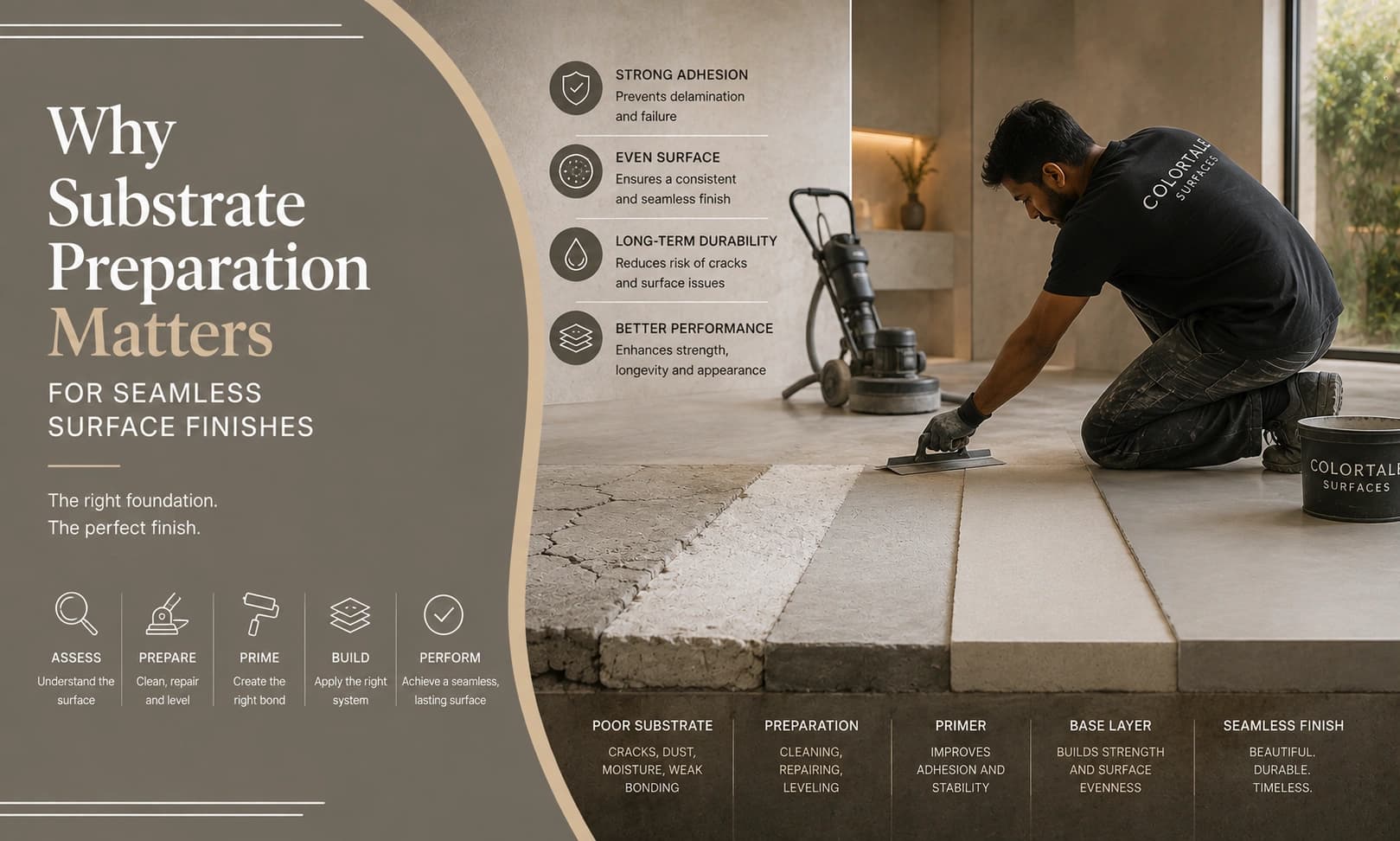
A seamless surface finish can look effortless when it is complete: continuous planes, minimal visual interruption, refined texture and clean transitions from one surface to another. But that apparent simplicity depends on a layer that is rarely seen—the substrate beneath it.
Whether the intended finish is Micro Cement, Micro Concrete, Micro Topping, Lime Plaster or another architectural surface system, the quality of the finished result begins with the condition of the surface receiving it. A substrate that is weak, contaminated, damp, uneven or moving cannot simply be hidden beneath a decorative finish and expected to perform properly.
This is particularly important with thin and seamless finishes. Unlike conventional construction materials that may provide substantial thickness or concealment, many contemporary surface systems are designed to remain visually refined and relatively thin. The condition of what lies beneath therefore becomes part of the technical equation.
For architects, interior designers and project teams, substrate preparation should not be treated as a preliminary site task. It is part of the surface specification itself.
What Is Substrate Preparation?
Substrate preparation is the process of assessing and conditioning an existing surface so that it is suitable for the specified finish system.
It can involve cleaning, removing unsuitable coatings, repairing defects, addressing cracks, correcting surface irregularities, controlling moisture, creating an appropriate surface profile and applying compatible primers or base layers where required.
But preparation is not simply about making a surface appear smooth.
A wall may look perfectly acceptable and still contain weak areas, contaminants, trapped moisture, poor adhesion, movement or incompatible previous coatings. Similarly, a floor may appear level from a distance while containing localised depressions, high spots or existing joints that can affect a thin seamless finish.
The objective is to create a substrate that is sound, suitably prepared, compatible with the proposed system and capable of supporting the finish throughout its intended service life.
That distinction is important because different finishes and substrates require different preparation strategies. There is no universal preparation method that can be applied to every architectural surface.
Why Does Substrate Preparation Matter for Seamless Finishes?
The performance of a seamless surface is determined by more than the decorative material itself.
A useful way to think about the complete system is:
Substrate → Preparation → Primer/Base → Decorative Finish → Protection → Maintenance
Each layer has a role, and the quality of one layer can influence the behaviour of the layers above it.
If the substrate is properly prepared, the finish has a more reliable foundation for adhesion and application. If the substrate is poorly prepared, problems can potentially appear later as cracking, debonding, uneven appearance, bubbling, staining or other forms of surface failure.
This does not mean every surface defect is caused by preparation. Material selection, application technique, environmental conditions, curing, detailing, movement and maintenance can all influence performance. However, substrate preparation is one of the fundamental variables that a project team can control before application begins.
For seamless finishes in particular, preparation also influences the visual outcome. Substrate irregularities can affect how light falls across the finished plane, while inconsistent absorption or inadequate surface conditioning can contribute to variations in texture or appearance.
The more minimal the design, the less visual noise there is to hide such imperfections.
Seamless Does Not Mean Substrate-Independent
One of the most common misconceptions about seamless finishes is that eliminating joints also eliminates the problems associated with the underlying surface.
It does not.
A seamless finish removes or reduces visible joints between surface elements, but it does not automatically remove movement, cracks, moisture, unevenness or weak areas within the substrate.
In fact, the continuous visual character of a seamless surface can make preparation even more important.
Imagine a large uninterrupted wall finished in a refined mineral texture. In a conventional tiled installation, individual tiles, grout lines and changes in pattern naturally break up the visual field. A seamless surface has fewer such interruptions. Variations in the underlying plane can therefore become much more noticeable.
The same principle applies to flooring.
A seamless floor is expected to read as one continuous surface. That means the substrate needs to be assessed not only for whether it can accept the material, but also for whether its condition is compatible with the visual and technical expectations of the finished floor.
Seamless describes the appearance of the finished surface. It does not mean that the layers underneath have disappeared.
What Happens When the Substrate Is Not Properly Prepared?
The consequences of inadequate preparation can range from visual inconsistencies to more significant adhesion or durability problems. Understanding the relationship between the underlying condition and the visible symptom is more useful than simply memorising a list of potential failures.
Cracking and Crack Reflection
Existing cracks deserve investigation before a seamless finish is applied.
A superficial crack may have a different cause from a crack associated with substrate movement, settlement or structural behaviour. Simply covering both with a decorative material does not address the underlying condition.
Where movement continues, it may eventually influence the surface above it.
This is why crack assessment and appropriate treatment should form part of the substrate evaluation rather than being considered an afterthought.
Delamination and Poor Adhesion
A finish needs a suitable surface to bond to.
Dust, grease, loose material, poorly bonded previous coatings, residues, excessive smoothness or other contaminants can interfere with adhesion. Applying a primer over an unsuitable surface does not necessarily solve the problem.
Preparation may therefore require cleaning, mechanical treatment, removal of incompatible materials or other substrate-specific measures before the primer or base system is introduced.
Uneven or Inconsistent Appearance
A thin decorative finish follows the character of the surface to which it is applied to a significant degree.
High spots, depressions, uneven repairs or inconsistent substrate absorption can influence the final appearance. On a highly refined interior, these differences may become particularly visible under directional or grazing light.
This is one reason why substrate preparation is simultaneously a technical consideration and a design consideration.
Moisture-Related Problems
Moisture is another factor that should be assessed before application.
Excess moisture or moisture movement through a substrate can affect adhesion, drying, appearance and the long-term behaviour of certain finish systems. The appropriate response depends on the substrate, source of moisture and proposed material system.
In bathrooms, kitchens, basements and other moisture-prone environments, this assessment becomes especially important.
A seamless decorative surface should not be treated as a substitute for appropriate waterproofing or moisture-management design where those systems are required.
Telegraphing of Existing Conditions
“Telegraphing” describes a situation where characteristics of the underlying surface become perceptible through the finished surface.
Existing tile joints, substrate irregularities, cracks, transitions or other imperfections may influence the appearance of a thin finish if they have not been appropriately addressed.
For architects and designers pursuing a calm, uninterrupted surface, this is an important consideration. The finished material may be aesthetically capable of creating the desired appearance, but the substrate has to support that visual objective.
How Professionals Assess a Substrate Before Application
A professional substrate assessment should happen before the finish is selected for application—not after the material has already been ordered and the site is ready for installation.
The first question is simple:
What exactly is underneath the proposed finish?
It could be concrete, screed, plaster, tiles, wood, an existing coating or another prepared surface. Each behaves differently and can introduce different preparation requirements.
The next consideration is the condition of that substrate.
Surface Soundness
The surface needs to be assessed for weak, loose, friable or poorly bonded areas. An apparently intact surface can contain localised problems that are not obvious during a casual visual inspection.
Cracks and Movement
Cracks should be examined rather than simply filled.
The nature and location of cracking can provide clues about the substrate and whether movement may continue. Appropriate treatment should be determined according to the cause and the requirements of the selected system.
Moisture
Moisture conditions need to be considered according to the substrate and finish.
This is particularly relevant for floors, bathrooms and other areas where moisture exposure or moisture migration may occur.
Flatness and Surface Profile
A seamless finish does not necessarily require every substrate to be perfectly flat in every application, but the required tolerance depends on the system and desired result.
High spots, low areas, tile lippage and unwanted transitions may need correction before the finish is applied.
Existing Coatings and Contamination
Paint, sealers, adhesives, grease, dust and other contaminants can affect adhesion.
The question is not simply whether an existing coating is present, but whether that coating is sound, compatible and appropriate as part of the proposed surface system.
Absorption and Porosity
Different substrates absorb primers and base materials differently. Understanding the substrate's porosity and surface characteristics helps determine how it should be conditioned before subsequent layers are applied.
This is why professional preparation cannot be reduced to a single instruction such as “clean the surface and apply primer.”
Substrate Preparation for Different Existing Surfaces
The preparation strategy should always respond to the existing substrate.
Existing Tiles
Tiles are increasingly relevant in renovation projects where designers want to transform an existing surface without completely removing the original finish.
Before applying a seamless system, tiles should be assessed for bonding, hollow or loose areas, surface contamination, lippage, joint configuration and other conditions that may influence the finished surface.
The existing grout lines and transitions may also require treatment depending on the system being specified.
For a deeper look at this renovation scenario, see Can Micro Cement Be Applied Over Existing Tiles?
Concrete and Screeds
Concrete and cementitious substrates can provide an appropriate foundation for several architectural surface systems, but their condition still needs to be assessed.
Dust, laitance, curing condition, cracks, contamination, moisture and surface profile can all influence preparation requirements.
A concrete substrate should therefore never be considered automatically ready simply because it is concrete.
You may also read: Micro Concrete vs Polished Concrete
Plastered Walls
Plastered walls require attention to cohesion, cracks, repairs, surface uniformity and any previous coatings.
A decorative finish intended to create a subtle, continuous plane will reveal much more about the underlying wall than a heavily patterned finish might.
Existing Painted or Coated Surfaces
Existing paint or coatings should be evaluated for adhesion and compatibility.
In some situations, the appropriate approach may involve removing an unsuitable coating rather than attempting to build a new system over it.
Furniture and Other Prepared Surfaces
When decorative finishes are applied to furniture, cabinetry or other elements, preparation becomes even more dependent on the material and existing construction.
The substrate must be appropriate for the complete finish system rather than simply visually acceptable before application.
Does Every Seamless Finish Need the Same Preparation?
No.
This is one of the most important principles to understand.
Micro Cement, Micro Concrete, Micro Topping, Lime Plaster, Decorative Paints and Liquid Metal are not interchangeable systems. Their preparation requirements can vary according to their formulation, thickness, application method, substrate and intended environment.
For example, a system designed as a thin cementitious overlay may require careful attention to existing joints, movement and surface stability. A mineral-based plaster system may require a different type of compatible base. A decorative paint system can have entirely different requirements related to existing coatings, absorption and surface uniformity.
Even within the same material category, preparation can change according to whether the application is on a floor, wall, bathroom, furniture element or another surface.
This is why the correct question is not:
“How do I prepare a surface for seamless finishes?”
It is:
“How should this particular substrate be prepared for this particular surface system?”
That shift in thinking is fundamental to successful architectural finishing.
How Substrate Preparation Changes for Micro Cement, Micro Concrete and Other Finishes
The preparation priorities can be broadly understood as follows:
| Surface system | Key preparation priority | What needs particular attention? |
|---|---|---|
| Micro Cement | Stable, suitably prepared substrate | Adhesion, movement, flatness and existing surface condition |
| Micro Concrete | Sound and compatible substrate | Stability, surface condition and suitability for the specified system |
| Micro Topping | Compatibility and surface uniformity | Existing surface, joints, adhesion and final appearance |
| Lime Plaster | Suitable, sound base | Substrate compatibility, cohesion and moisture behaviour |
| Decorative Paints | Clean and uniform surface | Existing coatings, contamination and surface absorption |
| Liquid Metal | Stable and carefully prepared base | Surface uniformity, compatibility and detailing |
This table is a framework, not a substitute for the technical requirements of an individual product system.
For example, when specifying Micro Concrete, the substrate should be considered alongside the intended application and system build-up. Likewise, the preparation required for Micro Topping can depend significantly on whether it is being applied to an existing floor, wall or another prepared surface.
The objective is always the same: create the right foundation for the material rather than forcing the material to compensate for an unsuitable one.
Why Primers and Base Layers Matter
Primers are often misunderstood as a universal solution for adhesion.
They are not.
A primer is one component within a surface system. Its purpose depends on the substrate, the finish and the manufacturer's specified application sequence.
A useful professional sequence is:
Inspect → Prepare → Repair → Clean → Condition/Profile → Prime/Base → Apply Finish
Skipping the earlier stages and relying on primer to correct a fundamentally unsuitable substrate can create a false sense of readiness.
The correct primer or base layer should therefore be selected as part of the complete system, not independently.
This is particularly important for premium architectural finishes where the final surface is expected to remain visually consistent over a large area.
What Architects and Designers Should Specify Before a Seamless Finish
For architects and interior designers, substrate preparation should become part of the specification conversation from the beginning.
A finish specification should consider the existing substrate, its condition, required repairs, moisture conditions, movement, surface tolerances and the preparation system required before application.
It should also account for areas where the finish meets other materials.
For example, a seamless floor may meet timber, stone, metal, glass or another finish. The quality of these junctions can influence how continuous and intentional the final space appears.
Wet areas require another layer of consideration. Bathrooms, shower zones and other moisture-exposed areas should be designed around the complete moisture-management system rather than treating the decorative finish as the only protective layer.
For higher-value or highly customised finishes, sample approval and site mock-ups can also be valuable. They allow the design team to assess texture, colour, variation, lighting response and workmanship before committing to the full surface.
You may also read What Architects Should Know Before Specifying Micro Cement to take a deeper dive.
Substrate Preparation Is Part of the Design Outcome
It is tempting to separate “technical work” from “design work.”
With architectural surface finishes, that distinction becomes increasingly blurred.
The substrate can influence how texture reads. It can affect the uniformity of a colour field. It can determine whether a large wall appears calm under natural light or reveals unwanted variations. It can influence transitions and detailing at corners, junctions and openings.
This is especially apparent in contemporary interiors where the design language relies on restraint.
A minimal space may contain fewer decorative objects, fewer patterns and fewer visual interruptions. As a result, the surface itself becomes part of the architecture.
In that context, preparation is not merely about preventing failure.
It is about creating the conditions in which the intended material expression can actually be seen.
That is why surface preparation should be approached with the same level of care as colour selection, texture development and finish approval.
Common Substrate Preparation Mistakes to Avoid
One common mistake is assuming that a surface is ready because it looks clean. Visual cleanliness does not confirm adhesion, stability or moisture suitability.
Another is treating cracks as purely cosmetic defects. Their cause matters, particularly where movement may continue.
Ignoring moisture is another significant risk, especially in floors and moisture-prone areas. A decorative surface cannot replace appropriate moisture management.
It is also a mistake to assume that the same preparation method works across every substrate. Concrete, tiles, plaster, painted surfaces and furniture substrates each present different conditions.
Finally, rushing preparation or curing stages simply to accelerate installation can compromise the very quality the finish was chosen to achieve.
The most sophisticated surface finish cannot compensate indefinitely for an unsuitable foundation.
A Better Way to Think About Seamless Surface Finishes
The most useful way to approach a seamless surface is to stop thinking of it as a single material.
Think of it as a surface system.
The substrate provides the foundation. Preparation creates compatibility. Primers or base layers establish the appropriate interface. The decorative finish creates the visual and tactile character. Protection and maintenance help preserve that result.
This system-based approach is particularly valuable when working with bespoke architectural surfaces, because appearance, application and performance are closely connected.
A finish should therefore be selected only after the project team understands the surface receiving it.
The Finish Is Only as Reliable as the System Beneath It
The appeal of seamless architectural finishes lies partly in their apparent simplicity. A continuous wall, floor or built-in surface can make an interior feel calmer, larger and more cohesive.
But achieving that simplicity requires discipline beneath the surface.
Substrate assessment, preparation, repair, compatibility, application and protection all contribute to the final result.
For architects and designers, this means the substrate should enter the conversation before colour, texture and final finish approval. For homeowners and project teams, it means asking not only “Which finish do we want?” but also “Is the existing surface suitable for that finish, and what needs to happen before application?”
At Colortale, this system-based approach is particularly relevant when working with architectural surface finishes where material character and craftsmanship need to work together. From Micro Cement and Micro Concrete to Lime Plaster, Micro Topping and other bespoke finishes, the quality of the finished surface begins well before the final layer is visible.
A seamless surface may appear effortless.
The preparation behind it should not be.