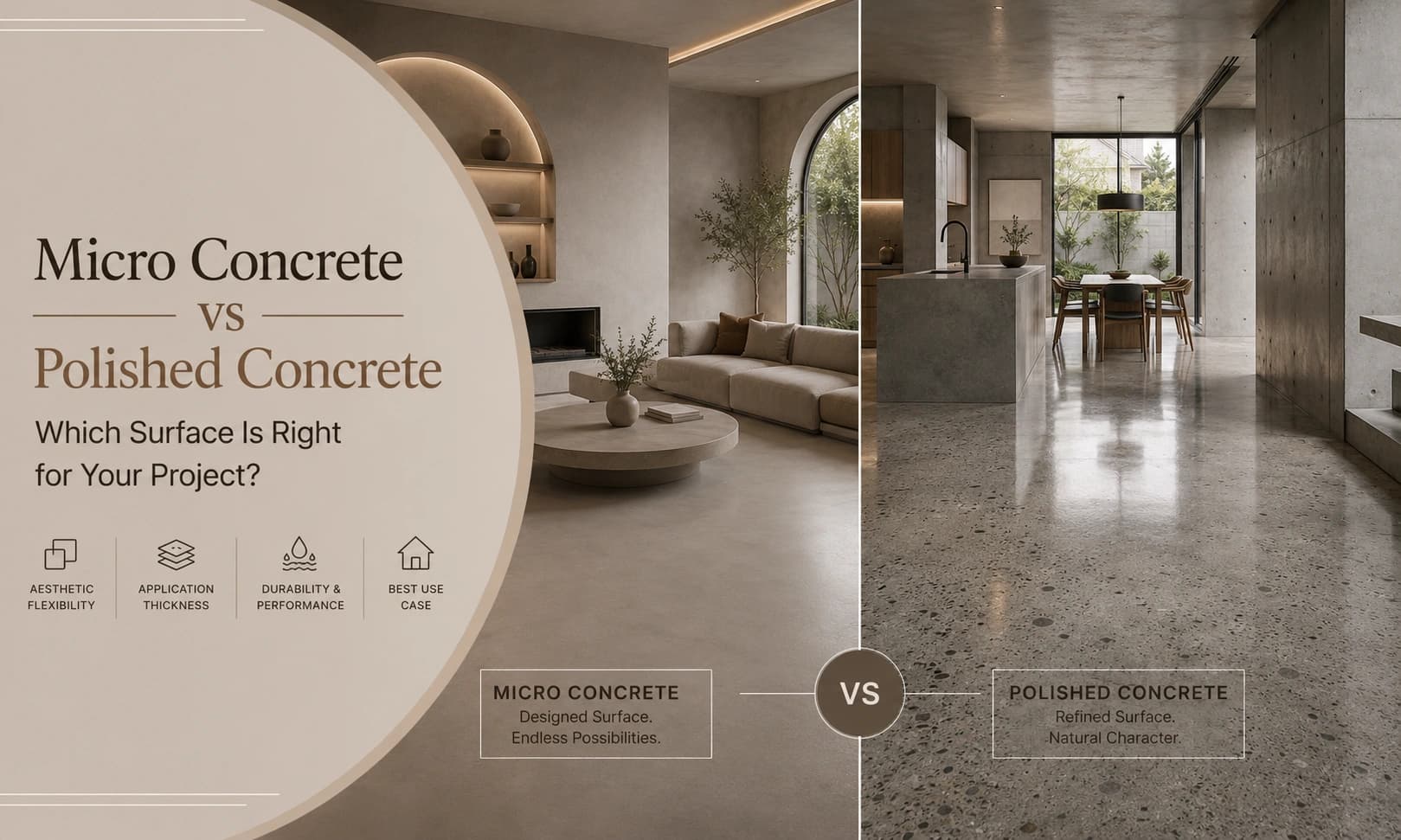
At first glance, Micro Concrete and polished concrete can appear to offer almost the same design outcome: a contemporary cement-inspired surface with minimal visual interruption.
But they are not simply two versions of the same material.
The biggest difference lies in what you are actually finishing.
A polished concrete surface is created by mechanically refining an existing concrete slab. The concrete itself becomes the finished floor. A decorative Micro Concrete system, by contrast, is designed as a surface finish that is applied to a suitably prepared substrate.
That difference affects almost everything else—from renovation suitability and substrate requirements to design flexibility, detailing, application and the type of project for which each surface makes sense.
There is also an important terminology issue.
The architectural-finishes market often uses Micro Cement, Micro Concrete, microtopping and similar terms inconsistently. Some manufacturers use “micro concrete” to describe structural repair or thin-section cementitious materials, while decorative surface specialists may use the term for a thin-build architectural finish. UltraTech, for example, describes micro concrete primarily as a high-flow, polymer-modified material for repairs and thin sections.
Therefore, before comparing the two, it is essential to understand the actual system being specified, rather than relying on the name alone.
For Colortale's decorative surface applications, the more useful comparison is between a Micro Concrete surface system and a true polished concrete floor.
Micro Concrete vs Polished Concrete at a Glance
| Consideration | Micro Concrete | Polished Concrete |
|---|---|---|
| Basic approach | Decorative surface system applied over a suitable substrate | Existing concrete slab mechanically ground and polished |
| Starting surface | Suitable prepared substrate | Concrete slab |
| Renovation potential | High where the substrate is suitable | Limited by the condition and existence of a suitable slab |
| Surface continuity | Can create a continuous visual finish | Slab joints and existing concrete detailing remain relevant |
| Colour control | Greater scope for specified colours and finishes | More dependent on the underlying concrete mix and aggregate |
| Application | Specialist surface application | Mechanical grinding, polishing and finishing |
| Walls | Can be used on suitable vertical surfaces | Primarily a floor/slab treatment |
| Furniture/built-ins | Can be considered for suitable substrates | Not generally a furniture finish |
| Substrate dependency | High | Extremely high—the slab itself is the finished surface |
| Best suited to | Contemporary interiors, renovations and multi-surface applications | Slab-led floors, new construction and suitable large-scale spaces |
The exact characteristics vary by system and project, so this table should be treated as a decision framework rather than a universal technical specification.
Also Read: Micro Cement vs Micro Concrete
What Is Micro Concrete?
For decorative architectural applications, Micro Concrete is a cement-based surface system designed to create a refined, contemporary mineral finish across suitably prepared surfaces.
Its attraction lies partly in its ability to create visual continuity without requiring a conventional concrete slab to become the finished surface.
Colortale positions its Micro Concrete system across applications including floors, walls, bathrooms and furniture, with residential, commercial, retail and hospitality uses.
This makes it particularly relevant to interiors where the designer wants a consistent material language across more than one architectural element.
A floor, wall, vanity, counter or selected built-in element can potentially share a related finish, helping the interior feel intentionally composed rather than assembled from disconnected surfaces.
However, Micro Concrete is not simply a decorative layer that can be applied indiscriminately.
The substrate needs to be stable and appropriately prepared, and the selected system needs to be suitable for the intended application.
This is particularly important in renovation projects.
What Is Polished Concrete?
Polished concrete is fundamentally different.
Rather than adding a decorative surface over another floor, the process refines the concrete slab that already exists.
Mechanical grinding progressively exposes and smooths the concrete surface, with the final treatment determining the degree of sheen and visual character.
The result therefore depends heavily on the concrete underneath.
Aggregate exposure, colour, existing repairs, cracks, joints, slab quality and construction history can all influence what eventually appears on the finished floor. Specialist comparison guides consistently identify this dependence on the existing or planned concrete slab as one of the fundamental differences between polished concrete and thin decorative cementitious systems.
This can be a major advantage when the slab itself is architecturally valuable.
Instead of trying to imitate concrete, polished concrete allows the actual construction material to become part of the aesthetic.
But it also creates a constraint:
you cannot polish qualities that the slab does not have.
If the concrete contains unwanted patches, poorly resolved joints or significant surface variation, those characteristics may become part of the finished floor.
The Fundamental Difference: Add a Surface or Refine the Slab?
This is the simplest way to understand the comparison.
Micro Concrete adds a designed surface
A suitable existing substrate becomes the foundation for the new finish.
That can make it particularly useful for renovation projects where removing the existing floor is undesirable or where the project requires a surface treatment rather than a new structural slab.
Polished Concrete reveals and refines the slab
The existing concrete is not covered.
It is progressively ground, polished and treated to become the finished surface.
That makes polished concrete especially compelling when the slab was intentionally designed or constructed with its eventual appearance in mind.
Neither approach is inherently superior.
They solve different architectural problems.
Micro Concrete vs Polished Concrete for Renovation
This is where the distinction becomes particularly important.
Suppose an apartment currently has a sound tiled floor.
The project brief calls for a contemporary mineral finish.
With a suitable Micro Concrete system, the existing substrate may potentially become part of the renovation strategy after proper assessment and preparation.
Polished concrete presents a completely different proposition.
There must be an appropriate concrete slab to grind and polish in the first place.
You cannot simply place polished concrete over tiles and call it polished concrete.
That is one of the most common misunderstandings surrounding the two finishes.
For renovation projects, therefore, the first question should be what exists beneath the current floor.
If there is no suitable concrete slab, polished concrete may require much more extensive construction work.
If there is a suitable slab, however, polishing it may be an attractive option.
Which Offers More Design Flexibility?
For projects where designers want control over the final visual expression, Micro Concrete flooring generally offers greater flexibility.
Colour, texture and surface character can be considered as deliberate design parameters.
This is particularly useful when the finish needs to coordinate with:
- natural stone
- timber
- metal
- cabinetry
- fabrics
- lighting
- decorative wall finishes
Polished concrete has its own appeal, but much of its character comes from the concrete itself.
Aggregate exposure, slab composition and the grinding process contribute to the finished appearance.
This can be precisely what an architect wants.
If the design objective is material honesty and the authentic character of the concrete slab, polished concrete may be more appropriate.
If the objective is a controlled architectural surface that can be integrated into a broader palette, Micro Concrete may offer greater creative flexibility.
Which Creates a More Seamless Surface?
Both can create visually continuous surfaces, but they achieve continuity differently.
A decorative Micro Concrete system can create a continuous surface without the modular grout lines associated with tiled flooring.
Polished concrete can also appear highly continuous, but the underlying slab remains a structural construction element. Joints and movement detailing therefore cannot simply be ignored.
This is one reason claims such as “polished concrete is completely joint-free” should be treated cautiously.
A decorative finish may visually minimise interruptions, but the structural behaviour of the substrate still matters.
For architects, this distinction is important:
Visual continuity does not eliminate the need for structural and movement detailing.
That principle should remain central to specification.
What About Thickness and Floor Levels?
Thickness can become an important consideration during renovation.
A decorative Micro Concrete system is designed as a relatively thin surface treatment, which can be advantageous where existing floor levels, doors, thresholds and transitions need to remain largely coordinated.
The exact build-up depends on the complete system and preparation requirements, so architects should always confirm the specified assembly rather than relying on a generic thickness figure.
Polished concrete works differently because the concrete slab itself is the floor.
The polishing process removes and refines the upper surface rather than adding a new decorative layer.
Therefore, the relevant architectural questions are different:
How thick is the existing slab?
What is beneath it?
How much grinding is possible?
Where are the joints?
What floor-level relationships need to be preserved?
This is another reason why the right choice depends heavily on whether the project is a new-build slab-led project or a renovation with an existing finished floor.
Micro Concrete vs Polished Concrete for Walls and Furniture
This is an area where the two options diverge considerably.
Micro Concrete can be considered for suitable walls and selected furniture or built-in applications because it functions as a surface system rather than as a structural slab treatment.
That opens up design opportunities for creating a related material language across floors, walls and architectural elements.
Polished concrete, by contrast, is primarily associated with refining concrete floors or slabs.
You would not normally specify conventional polished concrete simply because you want the same finish on a wall-mounted vanity or furniture element.
This makes Micro Concrete particularly interesting for material continuity across an interior.
The floor does not have to be treated as an isolated element.
The surface language can potentially extend into other parts of the architecture.
Which Is Better for Bathrooms and Wet Areas?
For typical residential bathrooms, Micro Concrete can offer a practical design advantage because it can be used across suitable floor and wall applications as part of a properly specified system.
It can therefore help create the visual continuity that makes contemporary bathrooms feel more architectural and less fragmented.
Polished concrete is fundamentally less flexible in this context because it depends on having a concrete slab that can be mechanically ground and polished.
But there is an important qualification:
Neither material should be described as automatically waterproof simply because it is cement-based.
Wet-area performance depends on the complete system, including substrate, waterproofing, detailing, protective treatments and correct application.
This distinction is particularly important for professional specification.
Which Is More Durable?
This question is more complicated than simply asking which material is “stronger.”
A polished concrete slab has a major structural advantage: the floor is the concrete itself.
There is no decorative overlay acting as the primary wear layer in the same sense as a thin surface system.
That can make polished concrete particularly attractive for large, heavily trafficked environments when a suitable slab is already present or intentionally designed for polishing.
Micro Concrete can also provide a durable finished surface when the correct system is specified, the substrate is appropriate, and application and protection are properly executed.
However, performance should always be assessed according to:
system + substrate + application + environment + maintenance
rather than assuming one material wins every durability comparison.
What About Cracks and Surface Movement?
This is one of the most important areas where both materials require realistic expectations.
Polished concrete is still concrete.
Concrete can crack and move, and existing joints and construction conditions remain part of the floor's behaviour. Grinding and polishing do not fundamentally change the structural nature of the slab.
Micro Concrete is thinner and therefore highly dependent on the stability of its substrate.
If the underlying surface moves significantly, that movement can affect the decorative finish.
This is why substrate assessment should happen before material approval, particularly for renovation projects.
A surface finish should not be expected to compensate for unresolved structural or substrate problems.
Which Requires More Site Work?
Again, the answer depends on the starting condition.
For a new project where a concrete slab is already being designed and constructed as the finished floor, polished concrete can be integrated into the construction process from the beginning.
For a renovation where an appropriate existing substrate is already present, Micro Concrete may offer a less disruptive route because the project can potentially transform the surface without completely rebuilding the floor.
This is one of the biggest reasons the two materials should not be compared purely on their material characteristics.
The project condition matters as much as the product.
Which Surface Should You Choose?
There is no universal winner.
The right choice depends on what you have, what you want and how the space will be used.
Choose Micro Concrete when:
You are renovating an existing interior and want to transform a suitable substrate.
You want greater control over colour and surface character.
You want a related finish across floors, walls or selected built-in elements.
You need a surface solution for applications where conventional polished concrete is impractical.
You want to minimise unnecessary demolition where the existing substrate is suitable.
Consider Polished Concrete when:
You already have a suitable concrete slab.
The slab itself is intended to become part of the architectural expression.
You want authentic aggregate and concrete character.
The project involves a large floor area where slab-led construction makes sense.
You are working on a new-build or commercial project where the concrete floor can be coordinated from the beginning.
The most important takeaway is simple:
Don't choose between Micro Concrete and polished concrete based on photographs. Choose based on the substrate, construction stage, design intent and performance requirements of the project.
A Practical Decision Framework
Before finalising the surface, ask:
What exists today?
A concrete slab, tiles, screed or another substrate will lead to very different options.
Is the substrate suitable?
Check stability, movement, moisture and existing defects.
Is this a renovation or new construction?
Renovation often favours surface systems that can work with suitable existing substrates. New construction may create opportunities to design and finish the slab itself.
What aesthetic do you want?
Do you want authentic aggregate and slab character, or a more controlled mineral finish?
How much colour control do you need?
Micro Concrete generally provides greater scope for specifying colour and surface character, while polished concrete is more strongly influenced by the concrete mix and aggregate.
Where will the surface be used?
A floor, bathroom, wall, furniture element and commercial entrance do not necessarily have identical requirements.
What level of traffic should it withstand?
Consider the actual use of the space rather than relying on generic durability claims.
How will junctions be resolved?
Think about doors, stairs, drains, skirting, stone, timber, cabinetry and changes in floor level before application begins.
Have you reviewed physical samples?
For Micro Concrete, this is especially important because colour and handcrafted surface character can vary under different lighting conditions.
Micro Concrete or Polished Concrete: The Bottom Line
Micro Concrete and polished concrete may create related visual experiences, but they solve fundamentally different problems.
Polished concrete turns a suitable concrete slab into the finished floor.
Micro Concrete creates a designed architectural surface over a suitable substrate.
That difference makes polished concrete particularly compelling when the slab itself is an intentional part of the architecture, while Micro Concrete can be more adaptable for renovations, customised finishes and projects where the surface needs to extend beyond the floor.
For architects, interior designers and homeowners, the best decision therefore starts with the project—not the trend.
Assess the substrate. Define the design intent. Understand the application. Review samples. Resolve the detailing. Then choose the surface system.
If you're evaluating Micro Concrete for a residential, commercial or hospitality project, Colortale can help you review finish options, physical samples and project-specific considerations before you finalise the specification.