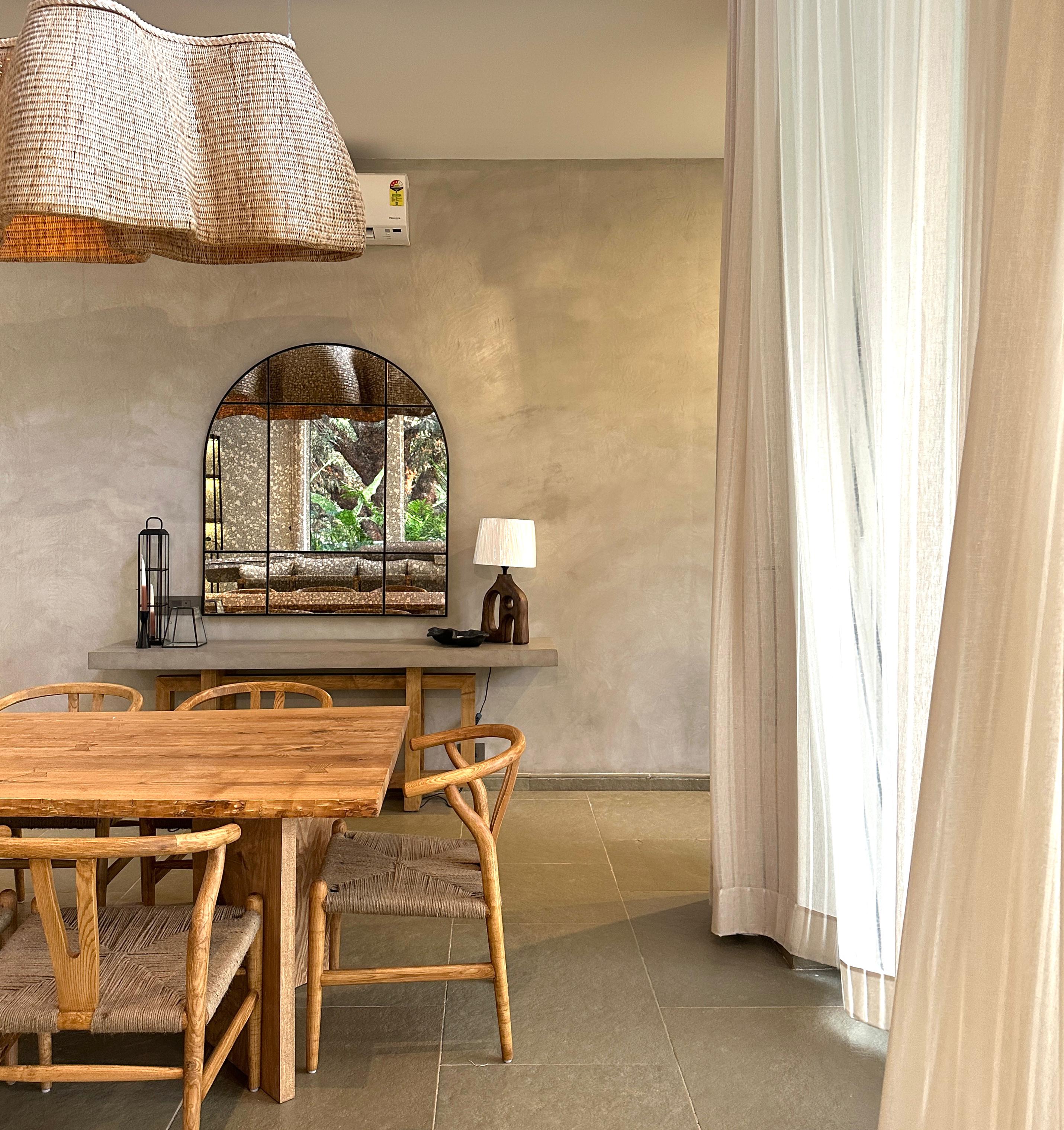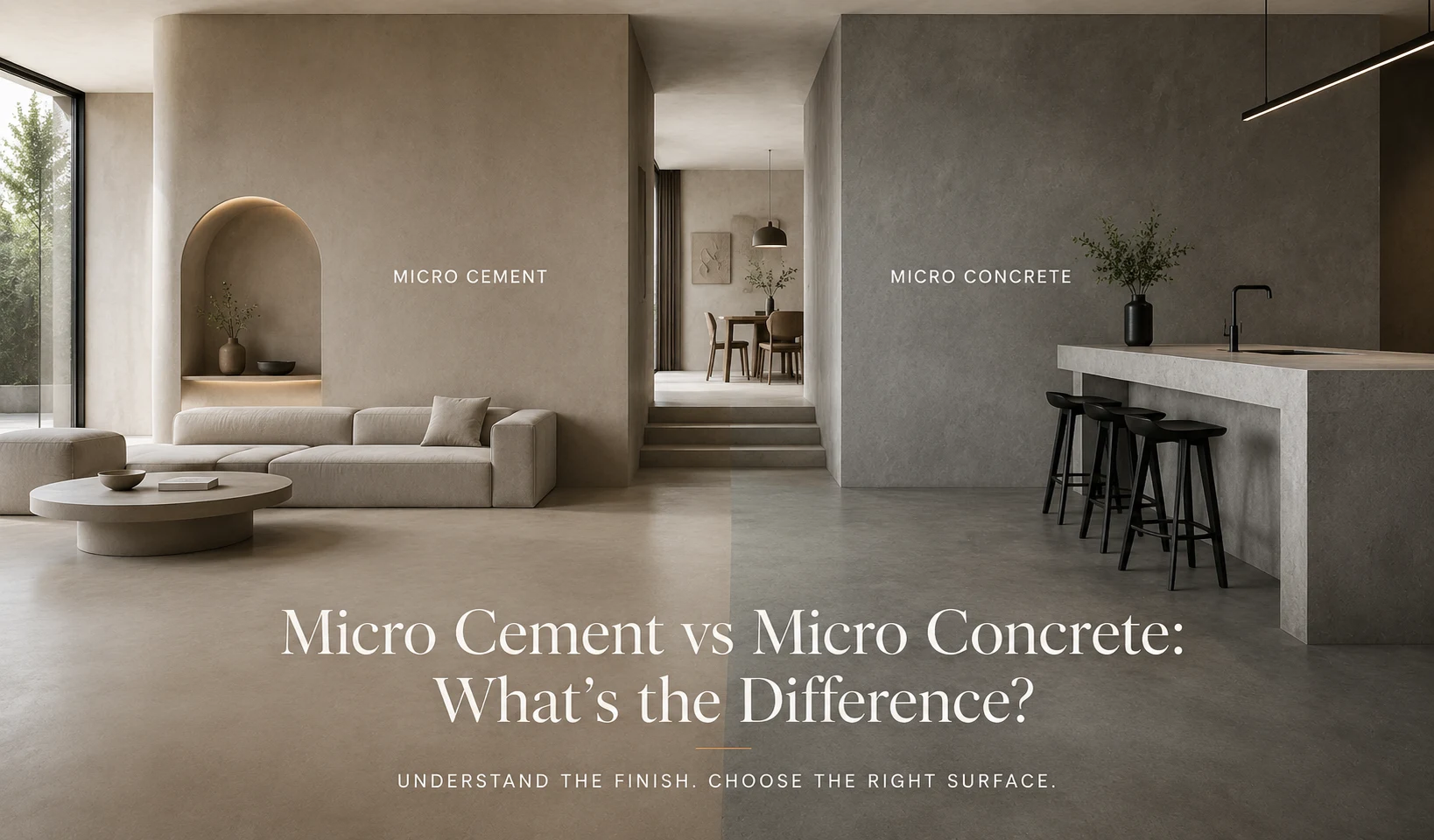
When planning a seamless or decorative surface, Micro Cement vs Micro Concrete can be a surprisingly difficult comparison. The names sound similar, both can create contemporary mineral-inspired finishes, and online explanations often blur the distinction between them.
Part of the confusion comes from terminology itself. Across the surface-finishing industry, “micro cement” and “micro concrete” are not always used in exactly the same way. Some manufacturers distinguish between the two systems, while others use the terms more interchangeably. This means choosing a finish based on the product name alone can lead to the wrong assumptions about its thickness, texture, application, or performance.
For architects, interior designers, homeowners, and developers, the more useful question is therefore not simply, “Which one is better?” It is:
Which surface system is better suited to the substrate, application, desired finish, performance requirements, and design intent of this particular project?
In this guide, we will compare Micro Cement and Micro Concrete in the context of decorative architectural surfaces and explain what really matters when choosing between them.
Micro Cement vs Micro Concrete: Quick Comparison
Before getting into the details, it helps to understand the comparison from a project-selection perspective.
| Consideration | Micro Cement | Micro Concrete |
|---|---|---|
| Material category | Decorative cementitious surface finish | Decorative cementitious surface finish |
| Design character | Seamless, contemporary and highly adaptable | Mineral, concrete-inspired architectural character |
| Application | Can be considered for multiple architectural surfaces according to the specified system | Can be considered for floors and other suitable architectural surfaces according to the specified system |
| Floors | Yes, where the system and substrate are suitable | Yes, where the system and substrate are suitable |
| Walls | Possible depending on the specified system | Possible depending on the specified system |
| Existing surfaces | May work over suitable prepared substrates | Depends on substrate and specified system |
| Customisation | Colour and texture possibilities | Colour and texture possibilities |
| Selection basis | Substrate, application, finish and performance requirements | Substrate, application, finish and performance requirements |
The table intentionally avoids universal claims such as “Micro Concrete is always thicker” or “Micro Cement is always more flexible.”
Why?
Because those characteristics depend on the specific formulation and system offered by the manufacturer. A technical property associated with one brand's Micro Concrete cannot automatically be assumed to apply to every product sold under the same name.
That distinction is essential when comparing specialist architectural finishes.
Are Micro Cement and Micro Concrete the Same Thing?
Not necessarily—but the terminology is not standardised consistently enough to assume that every manufacturer uses the two names to describe exactly the same technical distinction.
This is one of the most important things to understand before comparing micro concrete vs micro cement.
Within the broader market, you may find Micro Cement and Micro Concrete described as different decorative systems. Elsewhere, you may find “micro concrete” used as another term for microcement. The term “micro concrete” can also appear in completely different construction contexts, including specialised cementitious materials used for repair and structural applications.
For that reason, an online definition alone should not determine which product is specified for a project.
Instead, architects and buyers should evaluate the actual system being offered.
That includes its recommended applications, substrate requirements, system build-up, surface preparation, finish options, protective treatment, maintenance requirements, and relevant technical performance information.
In other words:
Compare systems, not just names.
For this article, Micro Cement and Micro Concrete refer specifically to the decorative architectural surface solutions offered as distinct finish categories by Colortale. They should not be confused with structural concrete repair products that may also be marketed using the term “micro concrete.”
What Is Micro Cement?
Micro Cement is a thin decorative cement-based surface finish designed to create continuous, contemporary surfaces over appropriately prepared substrates.
Rather than being installed as individual flooring or wall units, it is applied as a surface system. This allows designers to create an uninterrupted visual language without conventional tile joints across the main field of the finish.
Its architectural appeal comes from more than seamlessness.
Depending on the selected finish, Micro Cement can introduce subtle tonal movement, texture, and a mineral character while remaining visually restrained. This makes it relevant to interiors ranging from minimalist homes to hospitality, retail, and other design-led environments.
Another important advantage is its ability to work across different architectural elements where the specified system permits. Instead of thinking only in terms of a micro cement floor, designers can explore how the same broad surface language may interact with walls, furniture, feature elements, and adjoining spaces.
However, the finished decorative layer should never be considered independently from its substrate. Surface stability, cracks, moisture, preparation, intended use, and workmanship remain important to the final result.
This is why the previous guide on micro cement flooring focused heavily on what exists underneath the visible surface rather than simply discussing colours and design trends.
What Is Micro Concrete?
Micro Concrete, in the context of decorative architectural finishes, is a cementitious surface solution used to create a contemporary concrete-inspired finish across suitable project applications.
It should not automatically be understood as conventional concrete poured in a thinner layer, nor should decorative Micro Concrete be confused with every construction product carrying the same name.
Within an interior or architectural surface project, the objective is primarily to create a particular surface character and finish, while working with an appropriate substrate and application system.
This makes Micro Concrete relevant when architects, designers, or homeowners are looking for a mineral or concrete-led visual language without simply specifying a conventional exposed concrete slab.
As with Micro Cement, however, the product name alone tells only part of the story.
The correct Micro Concrete system needs to be evaluated according to the surface being treated, the condition of the substrate, intended traffic or use, desired texture, environmental conditions, and the manufacturer's application requirements.
This becomes particularly important when considering Micro Concrete flooring, where performance expectations can differ substantially between a private residence and a high-use commercial environment.
Micro Cement vs Micro Concrete: What Are the Key Differences?
This is where many comparison articles become overly simplistic.
It is common to find statements suggesting that one material is categorically stronger, thicker, smoother, more flexible, or better suited to a particular environment than the other.
Such distinctions may be accurate for specific proprietary systems, but they should not automatically be treated as universal definitions.
A better comparison starts with the factors that actually influence material selection.
Surface Appearance and Texture
The visual difference between Micro Cement and Micro Concrete should be evaluated using the actual finishes being considered for the project.
Both material families can contribute to contemporary, mineral-inspired interiors, but colour, texture, tonal movement, application technique, and finishing can significantly change their final appearance.
This matters because clients sometimes approach material selection with an image saved from another project and ask for “that exact Micro Cement look.”
The reference image may actually show another cementitious finish entirely.
More importantly, even within the same material category, changing the colour, application technique, texture, lighting, or surrounding materials can create a noticeably different result.
For that reason, physical samples are much more useful than relying exclusively on terminology or online photographs.
An architect comparing Micro Cement and Micro Concrete should ideally place actual samples alongside the project's timber, stone, metal, fabrics, cabinetry, and wall colours.
The question then changes from:
“Which product looks better?”
to:
“Which surface character belongs in this material palette?”
That is a far more useful design decision.
Thickness and System Build-Up
Thickness is frequently presented as one of the defining differences in online comparisons of Micro Cement vs Micro Concrete.
This needs caution.
The total build-up of a decorative surface system can depend on the specific product, substrate condition, preparation layers, reinforcement where required, application coats, and protective finish.
Therefore, a thickness figure quoted for another manufacturer's system should not automatically be applied to a Colortale project.
This is particularly important where floor levels matter.
Door clearances, transitions between adjoining materials, skirting details, stair interfaces, drains, fixed furniture, and existing flooring can all make build-up relevant to the project.
Rather than asking:
“How thick is Micro Cement compared with Micro Concrete?”
the project team should ask:
“What is the complete specified build-up for the selected system on this particular substrate?”
That answer is considerably more useful to an architect or contractor.
Application Areas
Both materials should be evaluated according to the architectural surface on which they will actually be used.
A floor presents different requirements from a feature wall. A bathroom differs from a bedroom. A residential living area differs from a retail store experiencing regular foot traffic.
This means application cannot be separated from specification.
For example, a finish selected primarily because it looks attractive on a vertical sample still needs to be assessed independently if it is proposed for flooring.
Similarly, a material that works within a dry interior should not automatically be assumed suitable for every wet or exterior environment without checking the complete system requirements.
Colortale offers both Micro Cement and Micro Concrete as distinct surface categories, so the most reliable approach is to match the specific system to the intended application rather than relying on generic assumptions associated with either name.
The Substrate Underneath
Here, Micro Cement and Micro Concrete share an important principle:
the decorative surface cannot be intelligently specified without understanding the substrate beneath it.
Existing tiles, concrete, screeds, previous coatings, cracks, moisture conditions, movement, surface irregularities, and other site conditions can influence what preparation is required.
This is especially relevant in renovation projects.
The attraction of transforming an existing floor without extensive demolition can be significant, but renovation suitability should never be assumed simply because a decorative finish is relatively thin.
The existing surface first needs to be assessed as a potential substrate.
A beautiful sample tells you what the final surface might look like.
A substrate assessment helps determine whether the project can support that finish successfully.
That is why material selection and site evaluation should ultimately work together rather than being treated as separate decisions.
Performance and Traffic Requirements
When comparing Micro Cement and Micro Concrete, performance should be evaluated in relation to how the finished surface will actually be used.
A floor in a private bedroom, for example, does not experience the same conditions as the entrance to a restaurant, a retail showroom, or a frequently used office. Foot traffic, furniture movement, cleaning routines, moisture exposure, and other forms of everyday use can vary considerably between projects.
This is why statements such as “Micro Concrete is stronger” or “Micro Cement is better for residential use” are not useful unless they refer to the technical characteristics of the specific systems being compared.
For a commercial project, the specification process should consider expected traffic, cleaning and maintenance routines, operational requirements, substrate condition, and the suitability of the complete surface system. For residential interiors, design character may carry greater weight, but practical performance should still be considered.
The principle remains the same:
Choose according to the performance required from the surface, then verify which specific system is designed to meet those requirements.
Colour, Texture and Customisation
Material selection becomes especially interesting when Micro Cement and Micro Concrete are considered as architectural finishes rather than simply construction materials.
Colour can determine whether the surface feels cool and industrial, warm and understated, earthy and natural, or more visually prominent.
Texture adds another layer.
A relatively restrained finish can allow furniture, artwork, lighting, and other materials to become the dominant elements in a room. A more expressive surface can instead become part of the visual identity of the space.
This flexibility is particularly valuable for architects and interior designers because the surface can be developed in relation to the wider material palette.
Rather than choosing a finish independently, it can be evaluated alongside wood, stone, metal, glass, textiles, lime-based finishes, and other architectural materials.
The objective should not necessarily be to make every surface match. Often, the more sophisticated approach is to create a controlled relationship between colour, texture, reflectivity, and material character.
Physical samples become important here. The same finish can appear noticeably different under daylight, warm artificial lighting, or directional lighting, so final selection should ideally consider the actual environment in which it will be used.
Finished Design Character
This is perhaps the most overlooked part of the difference between Micro Cement and Micro Concrete.
Material selection is not purely technical.
The floor or wall becomes part of the architecture, and its visual character influences how the entire space is perceived.
If the project requires a restrained seamless background, the chosen finish should support that objective. If the architect wants a more pronounced concrete-inspired or tactile surface, the material and finish should be selected accordingly.
The surrounding architecture matters as well.
A mineral surface beside warm timber may feel softer and more residential. The same broad finish beside black metal, exposed services, and large expanses of glass can take on a much more industrial character.
For this reason, asking whether Micro Cement or Micro Concrete is inherently “more premium” is not particularly helpful.
Premium design comes from appropriate material selection, detailing, execution, and the relationship between surfaces—not simply from the name of the finish.
Micro Cement vs Micro Concrete Flooring
Flooring is one of the most important areas in which the two materials are compared.
Both can be considered when a project is seeking a contemporary cementitious or mineral surface, but the final choice should account for much more than appearance.
Start with the substrate.
What floor currently exists? Is it new construction or renovation? Are there cracks, movement, moisture concerns, joints, or uneven areas? Does the proposed system require particular preparation?
Next, consider how the floor will be used.
A residential living room may prioritise visual continuity and integration with the interior palette. A hospitality or retail project may place greater emphasis on traffic, cleaning, maintenance, project scheduling, and operational requirements.
Then consider the desired finish.
Does the design require a subtle, quiet floor that visually connects several spaces? Or is a more pronounced mineral character part of the architectural concept?
These questions are more useful than choosing micro cement flooring vs micro concrete flooring solely from a small photograph.
There are also practical details to consider, including transitions to adjoining materials, floor build-up, door clearances, skirting, stairs, drainage where relevant, and interfaces with fixed furniture.
In other words, the flooring decision should combine:
design intent + substrate + use + detailing + system suitability.
Our detailed guide to micro cement flooring explores these flooring-specific considerations further, particularly substrate preparation, maintenance, wet areas, and renovation applications.
Which Is Better for Walls: Micro Cement or Micro Concrete?
Walls provide greater freedom to treat the finish as a visual and tactile design element.
Depending on the specified Colortale system, Micro Cement or Micro Concrete may be considered for suitable wall applications where a mineral, contemporary, or concrete-inspired appearance is desired.
But again, “better” depends on the result being pursued.
A feature wall intended to become a strong focal point may call for a different surface character from walls designed to remain quiet behind artwork, furniture, or architectural lighting.
Scale matters too.
A small physical sample may show colour and texture, but the same finish applied across a large wall can have a much stronger visual presence. Tonal movement that appears subtle on a sample may become an important part of the room once extended across several square metres.
Lighting can amplify this effect.
Directional or grazing light can reveal texture and application movement that may appear much less prominent under diffuse lighting. Architects should therefore consider not only the material itself but also how the wall will be illuminated throughout the day and evening.
For important projects, viewing physical samples under representative lighting conditions can significantly improve the selection process.
Which Is Better for Bathrooms and Wet Areas?
Bathrooms require a different level of technical consideration from dry interior walls and floors.
If either Micro Cement or Micro Concrete is being considered for a bathroom, the decision should involve the complete specified system, not simply the appearance of the decorative layer.
Relevant considerations can include substrate condition, waterproofing requirements, surface preparation, drainage, junctions, penetrations, slip considerations for floors, protective treatments, and maintenance.
This distinction matters because phrases such as “waterproof Micro Cement” can encourage buyers to think that the decorative finish alone solves every technical requirement of a wet area.
That is not how a bathroom should be specified.
Where waterproofing is required, it needs to be addressed appropriately within the overall construction and surface system. The selected decorative finish and its protective treatment must then be suitable for the intended environment.
Therefore, the answer to Micro Cement or Micro Concrete for a bathroom should come after the project team establishes:
what surface is being finished, how much water exposure is expected, what substrate exists, how waterproofing and drainage are being handled, and which specific Colortale system is suitable for those conditions.
A bathroom finish should never be selected from appearance alone.
Which Is Better for Residential Interiors?
For residential projects, the choice between Micro Cement and Micro Concrete often begins with the desired design language.
Homeowners may want seamless flooring across an open-plan living and dining area, a mineral feature wall, a contemporary bathroom, a textured bedroom surface, or continuity between different architectural elements.
Instead of asking which product is universally better for homes, consider three questions.
What should the space feel like?
The desired colour, texture, warmth, visual movement, and relationship with surrounding materials should guide finish selection.
Where will the material be applied?
Floors, walls, bathrooms, kitchens, stairs, and feature surfaces have different functional requirements.
What conditions exist underneath?
The substrate and existing construction remain relevant even when the decision begins as an aesthetic one.
For renovation projects in particular, this last question can significantly influence what is practical.
The strongest residential specification is therefore not necessarily the material that looks most impressive in isolation. It is the finish that works coherently with the architecture, substrate, everyday use, and wider material palette of the home.
Which Is Better for Commercial Spaces?
Commercial environments add another layer to the decision.
Retail stores, restaurants, cafés, offices, hotels, showrooms, and other commercial interiors may use decorative cementitious surfaces to create continuity and reinforce a particular design identity. However, these spaces can also place very different demands on a finish.
Expected traffic should be considered alongside maintenance routines, furniture movement, cleaning practices, moisture exposure, operating schedules, and the consequences of future repairs or maintenance.
Execution planning can also become more important.
In a commercial project, the surface applicator may need to coordinate with flooring contractors, carpenters, lighting teams, MEP services, furniture installation, and other trades. The timing and condition of the substrate when specialist finishing begins can influence the overall result.
For architects and developers, this means the comparison should extend beyond:
“Which one looks better?”
It should include:
Which system can be appropriately specified, detailed, executed, and maintained for this particular commercial environment?
That is the level at which Micro Cement vs Micro Concrete becomes a genuinely useful project decision rather than a superficial material comparison.
Can Micro Cement and Micro Concrete Be Used in the Same Project?
Potentially, yes—provided the selected systems are appropriate for their respective applications.
There is no architectural rule requiring an entire project to use only one decorative finish.
In fact, using different surface characters deliberately can create a more sophisticated material hierarchy.
A project might call for one type of continuous floor while another finish creates greater texture on a feature wall. A restrained mineral surface could form the visual background while a more expressive finish is reserved for selected architectural elements.
The key is restraint.
Using too many decorative surfaces simply because they are available can make an interior feel fragmented. Material variation works best when every finish has a clear role within the design.
Architects can therefore think in terms of:
dominant surfaces, supporting surfaces, and accent surfaces.
This approach also allows Micro Cement, Micro Concrete, Micro Topping, lime-based finishes, Liquid Metal, timber, stone, and other materials to participate in the same project without competing unnecessarily for attention.
The goal is not to showcase the maximum number of finishes.
It is to create a coherent material story across the space.
How Should Architects and Designers Choose Between Micro Cement and Micro Concrete?
For architects and interior designers, the most effective way to compare Micro Cement and Micro Concrete is to avoid beginning with the product name.
Begin with the project.
A finish that works beautifully in one interior may not automatically be the right solution for another because the substrate, application, performance requirements, lighting, surrounding materials, and desired surface character can all change.
A practical selection process can follow this sequence:
Surface → Substrate → Use → Performance → Design Intent → Finish → Sample → System Verification
Start With the Surface
First establish where the finish will actually be applied.
Is it a floor, wall, bathroom surface, feature element, staircase, furniture piece, or another architectural surface?
The answer immediately narrows the appropriate systems because the requirements of a vertical decorative wall are not necessarily the same as those of a frequently used floor.
Understand the Substrate
Next, identify what lies underneath.
New concrete, screed, existing tiles, previously finished surfaces, and other substrates can present different preparation requirements.
Existing cracks, movement, moisture, joints, and surface irregularities should also be identified before finalising the finish.
This is particularly important in renovation projects where the desire to avoid demolition can sometimes cause clients to focus on what can be applied over the existing floor without first asking whether that floor is a suitable base.
Define How the Surface Will Be Used
A decorative wall in a private bedroom and the floor of a busy retail environment have very different requirements.
Ask:
How much traffic will the surface receive? Will furniture move across it regularly? Is water exposure expected? How frequently will it be cleaned? Is it residential, hospitality, retail, or another commercial environment?
These questions help turn material selection into a performance-based decision.
Establish the Design Intent
Only after understanding the practical conditions should the project team ask what the surface needs to contribute visually.
Should it feel quiet and understated?
Should texture become noticeable?
Does the project require a strong concrete-inspired character?
Should the floor visually connect multiple spaces?
Does the finish need to complement timber, stone, metal, lime plaster, or other materials?
This is where the difference between two technically suitable finishes can become primarily an architectural decision.
Evaluate Physical Samples
Once the options have been narrowed down, physical samples become extremely valuable.
A sample should ideally be evaluated alongside the other materials proposed for the project rather than viewed on its own.
Lighting should also be considered.
A surface viewed beside a window in daylight may reveal different tonal movement and texture from the same finish under warm artificial lighting.
For a large or particularly important surface, the project team may also consider whether a larger sample or mock-up is appropriate before final approval.
Verify the Actual System
Finally, confirm the technical details of the specific product being specified.
This is particularly important when comparing Micro Cement vs Micro Concrete because terminology varies across the industry.
Rather than assuming that all products carrying the same name share identical properties, verify the actual Colortale system being considered for the particular substrate and application.
That final step protects the project from decisions based on generic online comparisons that may describe completely different proprietary systems.
Micro Cement or Micro Concrete: Which Should You Choose?
There is no meaningful universal winner in the Micro Cement vs Micro Concrete comparison.
The better choice is the system that responds most appropriately to the project's surface, substrate, intended use, performance requirements, design language, and desired finish.
Micro Cement may be considered where its particular finish characteristics and application possibilities align with the project. Micro Concrete may be preferred where its specific surface character and system properties better support the architectural requirement.
The important point is not to reverse-engineer a project around whichever material name appears more attractive.
Instead:
Define what the surface needs to do and how it needs to look, then select the system capable of delivering that result.
For homeowners, this means discussing more than colour.
For designers, it means evaluating the finish within the complete material palette.
For architects, it means combining design intent with substrate and specification requirements.
And for commercial projects, it means considering execution and maintenance alongside aesthetics.
Colortale offers both Micro Cement and Micro Concrete within its portfolio of decorative surface finishes. Comparing physical samples and discussing the intended application with the surface team can help determine which system is more appropriate for a particular project.