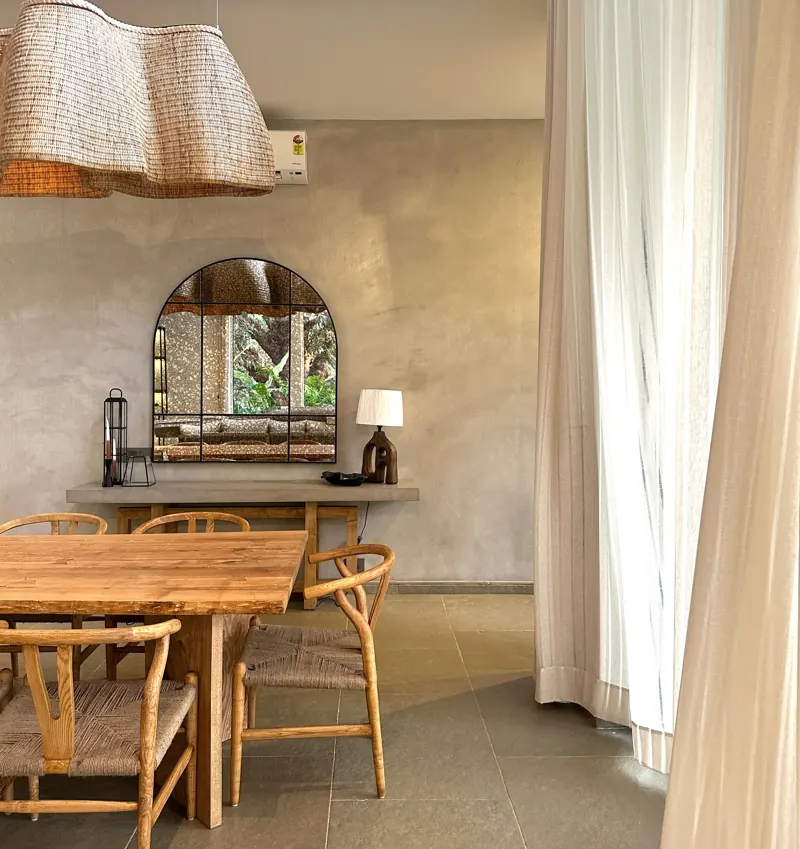
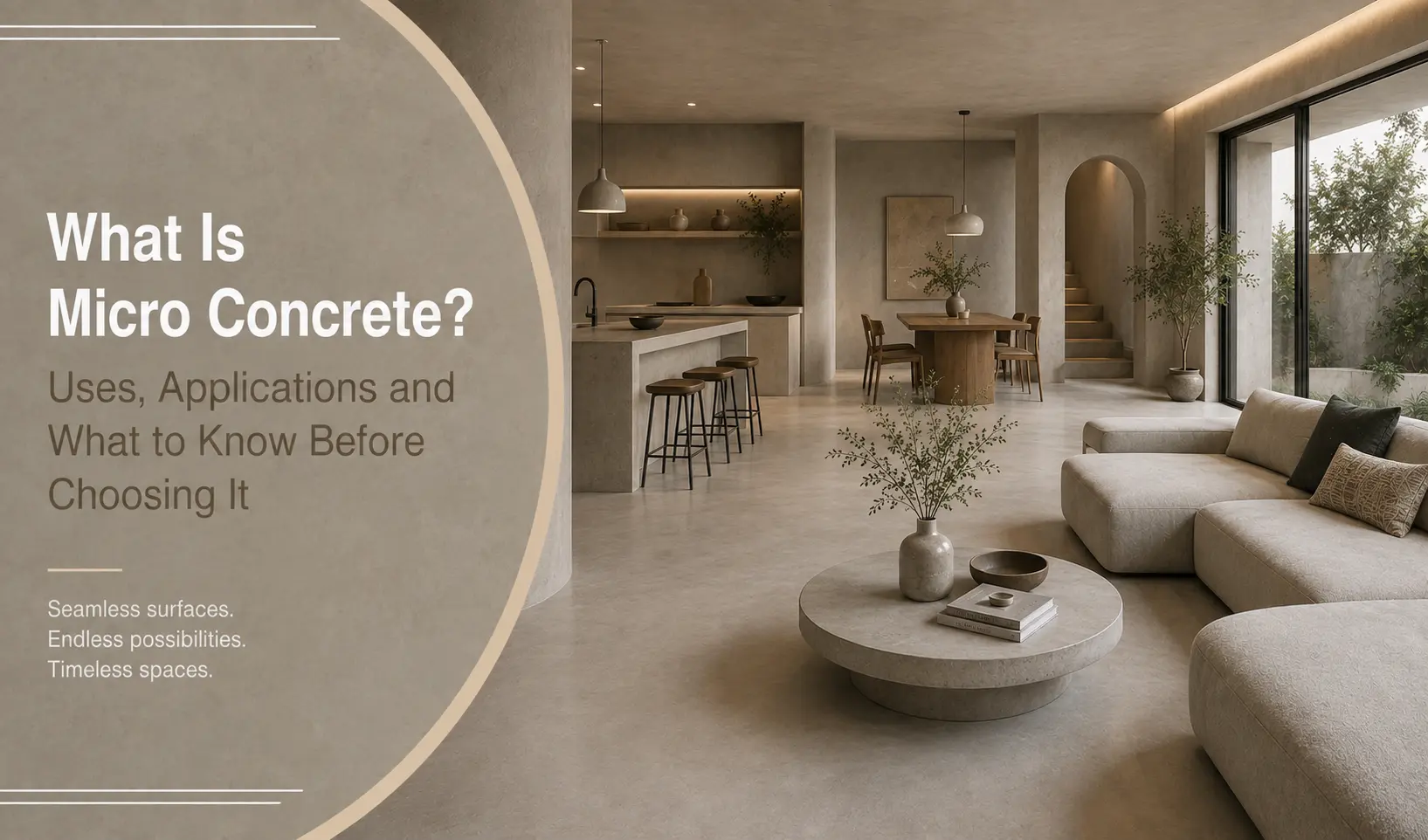
Micro Concrete is increasingly being considered for contemporary interiors where designers want the visual character of concrete without the visual interruption of conventional joints, heavy construction, or a bulky material build-up. Yet calling it simply a “thin concrete” can be misleading. Micro Concrete is a specialised cement-based surface system designed to combine material character with the practical demands of modern architectural applications.
For homeowners, architects and interior designers, the more useful question is not just what Micro Concrete is, but where it makes sense, how it behaves on different surfaces, and what should be evaluated before choosing it.
At Colortale, Micro Concrete is positioned as a high-performance decorative surface for applications including floors, walls, furniture and bathrooms, with the material system adapted to project requirements.
What Is Micro Concrete?
Micro Concrete is a cement-based composite material formulated to create a durable, refined surface that can be used for both functional and decorative applications. Unlike conventional concrete, which is generally associated with structural construction, Micro Concrete is used as a surface material where the visual expression of cement and concrete is desired without necessarily constructing an entire conventional concrete slab.
Its formulation can include cementitious components and fine materials such as micro silica, with the resulting characteristics depending on the specific formulation and application system. Colortale describes its Micro Concrete system as incorporating micro silica to improve density and performance while allowing applications across surfaces such as flooring, walls and furniture.
This distinction matters.
Micro Concrete should not be understood simply as conventional concrete made smaller. Its purpose, formulation, application technique and surface build-up are different. It is particularly relevant to projects where designers want a continuous, contemporary cement-inspired appearance while retaining flexibility in how the finish is integrated into an interior.
The appeal also comes from its ability to create a surface with visual depth rather than the perfectly uniform appearance associated with many conventional manufactured finishes. Depending on the chosen system, application technique and finish, the surface can have subtle tonal variation, texture and handcrafted character.
Micro Concrete vs Conventional Concrete
Traditional concrete is typically produced as a structural or construction material, often involving aggregates, reinforcement and a substantial slab or structural element. Micro Concrete, by contrast, is primarily considered in the context of surface finishing, overlays and decorative architectural applications.
This difference affects where each material belongs in a project.
Conventional concrete may form the structure itself. Micro Concrete is more commonly selected when the design objective is to achieve a concrete-like or mineral surface across an existing or prepared substrate.
It can therefore be particularly interesting in renovation and interior projects where introducing an entirely new structural concrete surface would be impractical.
The application does not require the same approach as conventional poured concrete, and the final result depends heavily on the substrate, preparation, material system and workmanship. This is one reason why the specification and execution process deserve as much attention as the material itself.
Why Is Micro Concrete Different From Conventional Decorative Finishes?
The biggest difference is the way Micro Concrete allows material continuity to become part of the design language.
Tiles naturally introduce grout lines. Stone introduces joints and individual slabs. Conventional painted walls provide a largely uniform colour field. Micro Concrete can instead create a more continuous mineral surface that visually connects different architectural elements.
That makes it particularly useful when the design calls for a restrained, contemporary or tactile aesthetic.
For example, a designer may use the same material language across a floor and adjoining wall, or continue a finish across selected built-in elements and furniture. Colortale’s existing Micro Concrete applications specifically include walls, floors and furniture, alongside residential, commercial and hospitality spaces.
However, continuity should not be confused with the absence of all construction movement or detailing. A successful surface still depends on appropriate substrate preparation, junction planning and application expertise.
This is where Micro Concrete moves beyond being simply a “look” and becomes a specification decision.
Where Is Micro Concrete Used?

One of the strongest reasons for considering Micro Concrete is its versatility across different architectural surfaces. The appropriate system and finish should always be selected according to the substrate, environment and expected use.
Micro Concrete Flooring
Micro Concrete flooring is one of the most commercially relevant applications. It can create a clean, contemporary surface with a restrained concrete character while reducing the visual interruption associated with conventional tiled flooring.
It can be considered for residential interiors as well as selected commercial, retail and hospitality environments where the desired finish and performance requirements are compatible with the application. Colortale specifically presents Micro Concrete flooring for residential, commercial and retail applications.
For flooring projects, however, aesthetics are only one part of the decision. Traffic, substrate stability, moisture, expected wear, finish selection and maintenance requirements should all be evaluated before specification.
Micro Concrete on Walls
Walls provide another opportunity to use Micro Concrete as an architectural surface rather than simply a flooring material.
A continuous mineral finish can create depth without relying on patterns or heavily decorative graphics. It can work particularly well as a backdrop for timber, stone, metal, soft furnishings and architectural lighting.
This makes it relevant to minimalist interiors where texture and materiality are expected to do more of the visual work.
Micro Concrete in Bathrooms
Bathrooms are another application where surface continuity can have a strong design impact.
Micro Concrete can be used to create a visually connected relationship between selected walls, floors, counters and other surfaces. Colortale currently positions its Micro Concrete bathroom applications around water resistance, durability and ease of maintenance.
However, a critical distinction should be made: the suitability of Micro Concrete for a wet area depends on the complete system and detailing, not merely the decorative coating itself. Waterproofing, substrate preparation, drainage, junctions, sealers and application quality all need to be considered.
That is exactly why a bathroom specification should be evaluated as a complete surface system rather than as a standalone finish.
Micro Concrete for Furniture and Built-In Surfaces
Micro Concrete does not have to be limited to floors and walls. It can also be considered for selected furniture and built-in surfaces, particularly when the design calls for a consistent material language across the interior.
Vanity units, counters, consoles, niches, shelving elements and other architectural features can be finished in a Micro Concrete system where the substrate and construction details are suitable. This creates an opportunity to visually connect furniture with the surrounding architecture rather than treating every element as a separate material.
For example, a Micro Concrete floor can transition into a similarly finished built-in counter or architectural bench, creating a restrained and cohesive interior. The effect can be particularly effective in minimalist homes, hospitality interiors and contemporary commercial spaces.
However, furniture applications require careful attention to edges, corners, movement and the underlying construction. A finish that performs well on a stable architectural substrate should not automatically be assumed to behave identically on every type of furniture substrate.
This is another reason why substrate assessment and professional application are important before specifying the finish.
Micro Concrete in Commercial and Hospitality Spaces
The visual simplicity of Micro Concrete can make it suitable for projects where the interior needs to feel contemporary without becoming visually busy.
Retail environments, cafés, restaurants, offices, showrooms, boutique hospitality spaces and other commercial interiors can use mineral surfaces to create a distinctive material identity.
In hospitality and retail, however, design decisions have to work alongside practical requirements. Traffic, cleaning routines, furniture movement, maintenance access and operational conditions can all influence whether a particular Micro Concrete system and finish is appropriate.
The right question is therefore not simply whether Micro Concrete can be used in a commercial space.
It is whether the selected Micro Concrete system, finish and application method are appropriate for that specific environment.
This distinction becomes particularly important when moving from a residential project to a high-use commercial environment.
What Are the Benefits of Micro Concrete?
The appeal of Micro Concrete comes from a combination of visual and practical characteristics rather than one isolated feature.
Seamless Visual Character
One of the strongest design advantages is the ability to create a more continuous visual surface. Fewer visible joints can help simplify the appearance of a space and allow architectural forms, furniture and lighting to become more prominent.
This can be particularly valuable in minimalist interiors where visual interruptions are intentionally reduced.
Contemporary Material Expression
Micro Concrete can bring the visual character of cement and concrete into spaces without requiring conventional exposed concrete construction.
Its mineral appearance can range from restrained and refined to more expressive and tactile, depending on the selected finish and application technique.
Versatility Across Surfaces
Unlike materials that are primarily associated with one application, Micro Concrete can be considered across floors, walls, bathrooms, furniture and selected built-in elements.
This creates opportunities for designers to develop a consistent surface language across different architectural components.
Design Flexibility
Colour, texture and surface character can be considered as part of the design process rather than treating the material as a fixed visual product.
For premium interiors, this flexibility can be useful when the surface needs to coordinate with timber, stone, metal, textiles, lighting and other materials.
Renovation Potential
Micro Concrete can be particularly interesting for renovation projects because selected systems may be applied over suitable existing substrates rather than requiring complete removal of the original surface.
However, this should never be interpreted as “Micro Concrete can go over anything.”
The condition, stability, compatibility and preparation of the existing substrate remain critical.
What Should You Know About Micro Concrete Texture and Finish?

A common mistake when selecting Micro Concrete is to evaluate it only by colour.
The texture and surface character can have an equally significant effect on the finished interior.
Two surfaces with a similar colour can look completely different depending on their texture, tonal movement, sheen, application technique and interaction with light.
A smoother finish may create a quieter and more refined appearance, while greater surface movement can introduce a more tactile, handcrafted character.
Lighting also matters.
Natural daylight, warm artificial lighting and directional spotlights can reveal different aspects of the same surface. A finish that appears subtle in a showroom or digital image may become considerably more expressive under strong directional lighting.
This is why architects and interior designers should ideally review physical Micro Concrete samples before final approval, especially for large or visually prominent surfaces.
The sample should be evaluated alongside the actual material palette rather than in isolation. Timber, stone, metal, upholstery, cabinetry and lighting can all change how the surface is perceived.
Can Micro Concrete Be Applied Over Existing Surfaces?
This is one of the reasons Micro Concrete attracts attention in renovation projects.
Depending on the system and substrate, it may be possible to apply a Micro Concrete finish over an existing surface instead of removing the entire underlying material. This can potentially simplify certain renovation projects and reduce the visual disruption associated with replacing a complete floor or wall assembly.
But substrate suitability is the deciding factor.
An existing surface should be evaluated for stability, movement, cracks, moisture, adhesion and overall condition before the Micro Concrete system is specified.
Loose tiles, unstable substrates, active movement or unresolved moisture problems cannot simply be hidden beneath a decorative finish and expected to disappear.
The same principle applies to micro concrete flooring and other large continuous surfaces. The larger the area, the more important substrate preparation and movement considerations become.
For renovation projects, the correct approach is therefore:
Assess the existing surface → resolve substrate issues → prepare appropriately → select the suitable system → apply under controlled conditions.
This qualification is one of the most important things to understand before choosing Micro Concrete.
What Are the Limitations of Micro Concrete?
No decorative surface is universally suitable for every project.
Micro Concrete has considerable design flexibility, but its final performance depends on the complete system and the quality of execution.
Substrate Dependency
The finish inherits much of its success from the surface beneath it. Movement, instability, moisture and inadequate preparation can affect the finished result.
Craftsmanship Matters
Micro Concrete is not simply a material that produces the same result regardless of who applies it.
Application technique, preparation, layering, finishing and detailing can influence the final appearance. This is particularly important when the design depends on subtle tonal variation or a handcrafted surface character.
Variation Is Part of the Material Character
Architects and clients should understand that a handcrafted mineral finish may not look exactly like a digitally rendered image or a perfectly uniform factory-made panel.
Colour and tonal variation can occur depending on the material, application and site conditions. That does not necessarily indicate a defect. It can be part of the visual character that makes a bespoke finish distinctive.
The key is to establish expectations through samples and, where appropriate, project-specific mock-ups before full application.
Detailing Cannot Be Ignored
Corners, junctions, transitions, drains, edges and connections with other materials need to be resolved as part of the design.
A beautiful uninterrupted surface can lose its impact if its transitions have been treated as an afterthought.
What Should You Check Before Choosing Micro Concrete?
Before selecting Micro Concrete for a project, evaluate the application as a complete system rather than choosing the material based solely on appearance.

Substrate Condition
Determine what surface exists, whether it is stable, and whether there are cracks, movement or moisture concerns.
Intended Application
A residential wall, bathroom floor, kitchen surface and commercial floor do not necessarily have identical requirements.
Traffic and Usage
Consider how frequently the surface will be used, what loads or wear it may encounter and how it will be maintained.
Colour and Texture
Decide whether the project calls for a restrained, uniform appearance or a more expressive handcrafted character.
Junctions and Transitions
Plan how Micro Concrete will meet tiles, stone, timber, metal, glazing, joinery and other materials.
Samples and Mock-Ups
For important projects, physical samples should be reviewed before final approval. Larger mock-ups can provide even greater confidence where colour, texture and detailing are critical.
Application Expertise
The team responsible for preparing and applying the finish should understand the specific requirements of the selected system.
Maintenance Expectations
The client should understand how the completed surface should be cleaned, maintained and used over time.
Micro Concrete for Architects and Interior Designers
For architects and interior designers, choosing Micro Concrete should begin with the design intent, not the product catalogue.
The material can create a strong sense of continuity, restraint and material depth, but the finished result depends on much more than the colour selected. Substrate conditions, surrounding materials, lighting, junctions, application technique and expected use all influence whether the finish ultimately supports the architectural concept.
This is particularly important for projects where Micro Concrete becomes a major visual element rather than a small accent.
A good specification therefore considers the material as part of the complete architectural system.
How Should Architects Choose the Right Micro Concrete Finish?
The right finish depends on the character the project is trying to create.
A minimalist residence may benefit from a quieter surface with subtle tonal movement. A hospitality project might deliberately use greater texture or visual variation to create a stronger sensory experience. A retail interior may require a balance between visual identity and practical maintenance.
There is no single “best” Micro Concrete finish for every project.
Instead, consider the relationship between colour, texture, sheen, lighting and surrounding materials.
Warm timber can make a cool mineral surface feel more balanced. Brass or metal elements can create contrast against a restrained cement-inspired finish. Natural stone can introduce variation alongside a quieter Micro Concrete surface.
This material-led approach is more effective than selecting a finish in isolation.
Why Physical Samples Matter Before Specification
Digital photographs are useful for narrowing down options, but they cannot completely communicate the character of a handcrafted surface.
Screen settings, photography, lighting and image processing can all alter how a colour or texture appears.
Physical samples allow architects, designers and clients to evaluate the actual finish alongside the project’s proposed materials.
For particularly important projects, a larger sample or project-specific mock-up can be even more valuable. It provides an opportunity to assess the surface under actual lighting and understand how the application technique translates at a meaningful scale.
A sample approval process can also establish expectations around tonal variation and texture before the full project begins.
This is especially valuable for premium interiors where the finished surface occupies a large visual area.
When Is Micro Concrete a Good Choice?
Micro Concrete can be a strong choice when the project calls for a contemporary mineral aesthetic, visual continuity and a surface that can participate actively in the overall material palette.
It can be particularly relevant when:
- The design benefits from reducing visual joints.
- A concrete-inspired aesthetic is desired without relying on conventional structural concrete.
- The project requires a surface that can be considered across multiple architectural elements.
- Renovation constraints make certain conventional replacement approaches less desirable.
- The client values handcrafted material character and customised finishes.
- The design team is prepared to coordinate substrate preparation, detailing and application properly.
These conditions make Micro Concrete particularly interesting for contemporary residential, hospitality, retail and commercial interiors.
When Might Micro Concrete Not Be the Right Choice?
Good material specification also means knowing when not to use a material.
Micro Concrete may not be appropriate where the underlying substrate has unresolved movement, significant instability or moisture problems. It may also be unsuitable where the project’s requirements demand a completely uniform, factory-controlled appearance.
Similarly, if the client expects a finish to require no maintenance or assumes that every surface will look identical to a digital reference image, expectations should be addressed before specification.
The question should never be:
“Can Micro Concrete be used here?”
Instead, ask:
“Is this Micro Concrete system appropriate for this substrate, environment, design intent and expected use?”
That distinction leads to better architectural decisions.
What Should Architects Consider at Junctions and Transitions?
A seamless-looking material does not mean that every architectural junction disappears.
Micro Concrete may meet timber, natural stone, tiles, metal, glass, cabinetry or other finishes. These interfaces should be considered during design development rather than left to the installation stage.
Transitions around doorways, stairs, drains, walls, furniture and changes in material can significantly influence the perceived quality of the finished project.
Architects should therefore identify important junctions early and communicate the intended visual outcome to the project team.
For complex projects, coordination between the architect, contractor and surface specialist can prevent avoidable site-level decisions from compromising the original design intent.
Why Craftsmanship Is Part of the Material Specification

One of the most important things to understand about Micro Concrete is that the material and its application cannot always be separated.
The substrate, preparation, application technique, finishing process and site conditions all contribute to the final appearance.
Two projects using a similar material system can therefore have noticeably different visual outcomes.
For architects, this means that the applicator’s experience should form part of the specification conversation.
The objective is not merely to select a material that looks right in a sample. It is to ensure that the selected system can be successfully translated from sample to architectural surface.
This is where Colortale’s emphasis on craftsmanship becomes particularly relevant. The company describes its approach around customised finishes, specialised techniques and experienced craftsmen working to bring surface concepts into completed spaces.
How Should Micro Concrete Be Maintained?
Maintenance expectations should be discussed before the project is completed, not after the surface has already been installed.
The appropriate cleaning and care routine depends on the specific system, protective treatment, location and level of use. High-traffic commercial spaces may have different maintenance requirements from a residential feature wall.
The project team should therefore follow the care and maintenance recommendations provided for the selected system.
It is also important to distinguish between normal ageing and surface failure. A handcrafted finish may naturally develop subtle changes in appearance through use, while cracking, adhesion problems or other performance issues may indicate an underlying technical concern.
Clear maintenance guidance helps clients understand how the surface should be treated throughout its service life.
A Practical Micro Concrete Decision Framework
Before approving Micro Concrete, architects, designers and homeowners can work through a simple sequence of questions.
What is the design objective? Is the goal seamless continuity, a concrete-inspired aesthetic, tactile depth or a restrained mineral backdrop?
What substrate exists? Is the surface stable, dry and suitable for the proposed system?
Where will the material be used? Floor, wall, bathroom, furniture, commercial area or another application?
How will the surface be used? Consider traffic, cleaning, furniture movement and environmental exposure.
What finish is required? Define colour, texture, tonal variation and the desired level of visual movement.
How will it interact with other materials? Resolve junctions with stone, timber, metal, tiles and joinery.
Has the finish been physically approved? Review samples and consider a mock-up for significant projects.
Who will execute the work? Application expertise is an important part of the final result.
What are the maintenance expectations? Make sure the client understands appropriate cleaning and long-term care.
If these questions have clear answers, the project is in a much stronger position for successful specification.
Is Micro Concrete Right for Your Project?
Micro Concrete is most compelling when it is selected intentionally.
It can provide the visual continuity of a carefully considered seamless surface, the mineral character associated with concrete and the flexibility to become part of a broader architectural material palette.
But its success is not determined by the material alone.
The substrate, specification, finish selection, detailing, application conditions and craftsmanship all contribute to the final outcome.
For this reason, Micro Concrete should be approached as a complete surface system rather than a decorative coating chosen solely from a photograph.
For architects and interior designers, that approach also creates greater freedom. Instead of asking which finish is currently trending, the design team can determine which surface character genuinely supports the architecture.
Final Thoughts
Micro Concrete occupies an interesting position between material expression and practical surface design.
It can transform floors, walls, bathrooms, furniture and selected architectural elements into visually connected surfaces, while allowing designers to work with colour, texture and tonal character.
But the most successful applications begin long before the material reaches the site.
They begin with understanding the design intent, substrate, application environment, expected use, material relationships and desired finish.
For architects and interior designers, that makes the specification process as important as the material itself.
When the right system is selected for the right application—and supported by appropriate preparation and skilled craftsmanship—Micro Concrete can become more than a concrete-inspired finish.
It can become part of the architectural language of the space.
Explore Micro Concrete With Colortale
If you are considering Micro Concrete for a residential, commercial, hospitality or renovation project, the Colortale team can help you evaluate finish options and project requirements before final specification.
You can review physical samples, discuss the intended application and understand which finish may work best with your project’s material palette and design direction.
Discuss a Project to take the next step toward a considered surface specification.