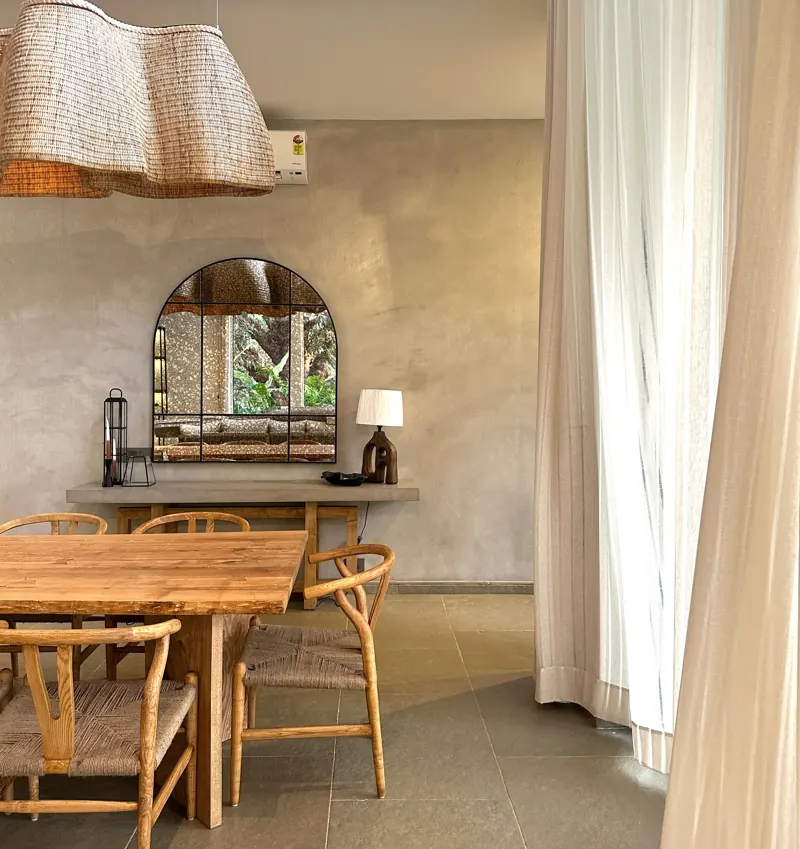

It is interesting to explore the fact that over the past few years, the way designers think about surfaces has quietly evolved. We don't see finishes just as mere background layers applied at the end of a project anymore but as material expressions shaping the identity of a space.
We see customers finding paint often too flat, tiles too segmented and laminates too predictable. We find these same customers getting accustomed to opting for lime, real metal and microcement not just as decorative upgrades — but as conscious material choices. They have started developing an understanding as they explore that these systems don't function as conventional coatings, but they are mineral – engineered or metallic in nature – the ones that respond to substrate, climate, craftsmanship and detailing.
Now let's understand what a designer really needs to evaluate while selecting these materials and finishes.
1. Material Composition and Authenticity
One cannot treat 'lime' or 'metallic finishes' equal. True lime plasters such as Veniso, Intonachino or Tadelakt are composed of aged slaked lime and marble powders — materials that breathe, mineralise over time and develop depth.
Similarly, authentic metal finishes like Ossidaire or Fuso Mettalo use real metal powders (copper or iron), not imitation pigments.
Talking of microcement systems such as Cemento or Pastellone, they rely on engineered binders and layered reinforcement for durability.
What needs to be evaluated?
- Is the base mineral or synthetic?
- Does the finish breathe?
- Is it real metal or metallic paint?
- What binders are used?
- What is the long-term aging behaviour?
Material honesty directly affects longevity and character.
2. Substrate and Surface Preparation
Speciality finishes are only as strong as their base. Lime plasters often require smooth levelled plaster or POP surfaces.
Microcement can be applied over tiles or marble — but substrate stability, crack management and moisture control are critical.
Metal finishes demand properly sealed and compatible substrates to avoid oxidation irregularities.
What are the design considerations?
- What is the existing base?
- Is movement expected?
- Are expansion joints required?
- Is waterproofing integrated (especially in bathrooms and exteriors)?
Ignoring preparation leads to performance compromise.
3. Performance in Indian Climatic Conditions
Humidity, temperature variations and dust exposure vary dramatically across regions.
Hydraulic lime-based systems such as Venetian Facade are engineered for humid exteriors and offer mould resistance.
Tadelakt-style lime finishes offer inherent water resistance when correctly applied.
Microcement floors must be sealed appropriately depending on foot traffic and use-case — residential, hospitality or commercial.
What needs to be considered?
- Is the finish suitable for interior, exterior or both?
- How does it respond to moisture?
- What protection systems are specified?
- What maintenance cycle is expected?
Specification must reflect climate reality, not just design intent.
4. Craftsmanship and Application Skill
Lime, metal and microcement are artisanal systems — not single-coat applications.
Burnishing lime plasters require trained hands. Microcement is built in multiple reinforced layers. Real metal finishes oxidise through controlled chemical processes. The artistry lies in technique.
What needs to be seen when talking of evaluating execution capability?
- Is there a trained team?
- Are samples mock-tested?
- Is there process documentation?
- How is quality consistency maintained across large sites?
Without skilled application, even the finest material fails.
5. Seamlessness and Design Intent
One of the greatest advantages of speciality surfaces is joint-free continuity.
Microcement creates uninterrupted walls and floors. Lime plasters produce depth without panel lines. Liquid metal finishes allow sculptural integration across furniture and verticals.
What needs to be considered while planning to go seamless?
- Where do transitions occur?
- How are edges detailed?
- What happens at junctions (glass, wood, stone)?
Surface detailing must be resolved during design development — not on site.
6. Sustainability and Indoor Health
Designers today carry responsibility beyond aesthetics.
Lime-based finishes are naturally breathable and low in VOCs. Mineral-based plasters contribute to healthier indoor air quality. Water-based metal systems reduce toxic exposure.
What needs to be evaluated here?
- VOC certifications
- Breathability
- Antibacterial properties
- Long-term environmental footprint
Sustainable luxury is no longer optional — it is expected.
7. Maintenance and Lifecycle Value
A common misconception is that speciality finishes are fragile.
In reality, correctly specified and sealed lime, metal and microcement systems are durable and low-maintenance.
What are the key considerations?
- Correct sealer selection
- Appropriate use-case placement
- Clear post-installation care guidelines
Designers must specify not just the finish — but the protection system and maintenance protocol.
8. Customisation and Co-creation Potential
Unlike mass paints or tiles, speciality finishes allow nuance.
| Tone variation | Texture depth | Burnish levels | Oxidation control | Gloss calibration |
Each project can be uniquely interpreted.
How does the question modify?
- Does the material allow design collaboration?
- Can samples be customised?
- Is scale achievable without losing individuality?
Moving from Decorative to Experiential
When it comes to selecting lime, metal and microcement, it doesn't just stay restricted to choosing a product, but it becomes all about choosing a material language.
It's about paint offering uniformity, speciality surfaces offering depth.
It's about tiles offering rigidity, seamless systems offering fluidity.
It's about laminates offering imitation, mineral and metal systems offering authenticity.
The way world is changing and discovering new in every single second, it becomes vital for designers shaping contemporary Indian spaces — residential, hospitality, retail or corporate — to move beyond colour charts, and experience material science, craftsmanship, sustainability and lifecycle performance.
At Colortale, we work alongside architects and designers to ensure that every specification balances artistry with reliability — delivering seamless speciality surfaces crafted with precision, responsibility and scale.
Everyone building up Colortale believes that when surfaces are specified thoughtfully, they do not merely finish a space, they define how it is felt.