
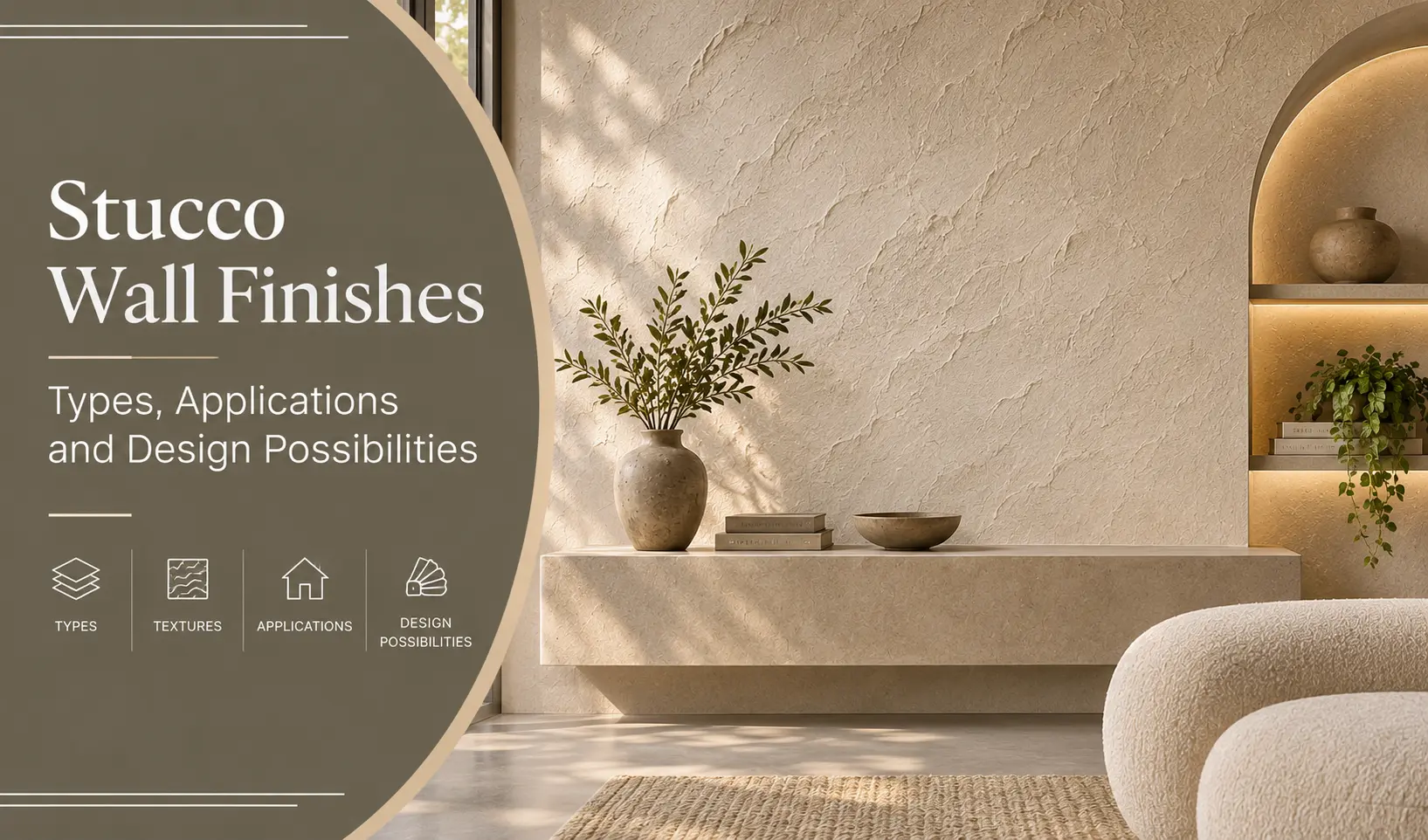
Walls are often treated as backgrounds in interior design. But the right wall finish can become one of the most defining elements of a space, influencing its texture, visual depth, relationship with light and overall architectural character.
Stucco is one such finish that offers considerable design flexibility. From smooth, understated surfaces to grainy textures, layered patterns and handcrafted effects, stucco can transform ordinary walls into distinctive architectural features.
Traditionally associated with exterior façades and classical architecture, stucco has also found a place in contemporary residential, hospitality and commercial interiors. Modern decorative stucco finishes offer different colours, textures and surface treatments, making them suitable for a wide range of design styles.
However, not every stucco finish is made from the same material, and not every texture is suitable for every application.
Understanding the different types of stucco, their visual characteristics, application methods and practical requirements helps architects, interior designers and homeowners make better material decisions.
In this guide, we explore what stucco is, the different stucco wall finishes available, where they work best, and how to select the right finish for your project.
What Is Stucco?
Stucco is a plaster-like material applied to building surfaces to create a protective and decorative finish. Traditional cement-based stucco commonly contains Portland cement, sand, lime and water, although modern stucco systems may use different binders, additives and formulations.
Once applied and cured, it forms a hard surface that can be finished in different ways to achieve smooth, textured, patterned or decorative appearances.
Stucco has traditionally been used on exterior walls and façades because of its ability to create a durable architectural coating. It is also used on interior walls and ceilings where designers want more material character than a conventional painted surface provides.
Depending on the selected system, stucco can create:
- Smooth and refined wall surfaces
- Fine-grain or sand-textured finishes
- Rough and rustic textures
- Layered decorative patterns
- Subtle tonal variations
- Contemporary architectural surfaces
At ColorTale, stucco is approached as a customisable decorative surface solution, with smooth, modern and textured appearances for residential, commercial and hospitality environments.
Explore ColorTale's Stucco finishes to understand the available surface possibilities.
Understanding the Different Types of Stucco
Before exploring individual textures, it is important to understand that stucco can be classified in two different ways:
1. By material or system: This describes the composition and construction of the stucco finish, such as cement-based, lime-based or acrylic-modified systems.
2. By appearance or texture: This describes the finished surface, such as smooth, sand, dash, lace or knockdown textures.
These classifications are related, but they are not interchangeable. A sand finish describes an appearance, whereas cement-based or acrylic-modified describes a material system.
Types of Stucco by Material and System
1. Traditional Cement-Based Stucco
Traditional stucco is commonly made using Portland cement, sand, lime and water.
It is widely associated with exterior wall rendering and architectural façades, although suitable systems can also be used for selected interior applications.
Its appearance can range from relatively smooth to visibly textured, depending on the aggregate, finishing method and application technique.
Design and application considerations:
- Exterior façades and masonry surfaces
- Traditional and contemporary architectural buildings
- Textured wall surfaces
- Residential and commercial construction
Traditional cement-based stucco requires appropriate substrate preparation, curing and detailing. Its performance should be evaluated as part of the complete wall assembly rather than judged by the visible finish alone.
2. Lime-Based Stucco
Lime-based stucco uses lime as a principal binder, often combined with sand and other compatible aggregates.
It is associated with traditional architecture, restoration work and decorative surfaces that benefit from a mineral appearance.
Depending on the formulation, lime-based materials can allow greater water-vapour movement than some less permeable coatings. However, actual moisture behaviour depends on the complete material system and wall construction.
Design and application considerations:
- Heritage-inspired architecture
- Traditional and artisanal interiors
- Mineral-looking wall finishes
- Projects where substrate compatibility and vapour movement are important
Lime-based stucco should not automatically be considered waterproof or suitable for continuous water exposure.
3. Acrylic and Polymer-Modified Stucco
Acrylic and polymer-modified stucco systems incorporate synthetic binders or additives to influence flexibility, adhesion, finish characteristics and colour performance.
They are commonly used in decorative coating systems and selected exterior applications.
Depending on the product, these systems can offer a range of colours and textures, including fine-grain and more pronounced decorative appearances.
Design and application considerations:
- Contemporary decorative façades
- Selected interior and exterior wall finishes
- Custom colours and surface textures
- Projects requiring a specified flexible finish coat
The properties of one acrylic stucco product should not be assumed to apply to every polymer-modified system. Always follow the manufacturer's application and compatibility requirements.
4. Synthetic Stucco and EIFS
Synthetic stucco is a term sometimes used for polymer-based exterior finishes. EIFS, or Exterior Insulation and Finish Systems, is a more specific type of exterior wall assembly.
An EIFS system typically includes insulation board, attachment components, a reinforced base coat and a protective textured finish coat. Some systems also incorporate dedicated drainage provisions.
Although EIFS can resemble traditional stucco from the outside, it is not simply another decorative stucco texture. It is an engineered exterior cladding system with its own installation, detailing and performance requirements.
Design and application considerations:
- Exterior building envelopes
- Projects requiring continuous exterior insulation
- Lightweight façade systems
- Architecturally detailed exterior surfaces
EIFS components should be specified and installed as a compatible system rather than assembled by mixing unrelated products.
5. One-Coat and Three-Coat Stucco Systems
One-coat and three-coat stucco describe different application or construction approaches rather than decorative texture categories.
Traditional three-coat stucco generally involves a scratch coat, a brown coat and a finish coat.
One-coat systems use a different specified build-up and application process to achieve the required wall finish.
The correct system depends on the substrate, project specification, manufacturer instructions and applicable construction requirements.
Important: A one-coat stucco system does not automatically mean that every decorative stucco product can be applied in one coat.
Types of Stucco Wall Textures and Finishes
The visual character of stucco depends considerably on how the material is applied and finished.
The following are recognised stucco texture styles. Their availability and suitability depend on the selected material system and the applicator's capabilities.
1. Smooth Stucco Finish
A smooth stucco finish creates a clean, refined surface with minimal visible texture.
It is particularly suited to contemporary architecture, where simple forms, neutral colours and understated materials play an important role.
Unlike heavily textured finishes, smooth stucco allows the overall architecture, furniture and lighting to remain the primary visual elements.
Where it works best:
- Modern residential interiors
- Minimalist living rooms
- Contemporary façades
- Office reception areas
- Architectural feature walls
Smooth finishes require careful substrate preparation and skilled application because surface irregularities can become more noticeable under direct or grazing light.
2. Sand or Float Finish
A sand finish creates a fine, grainy surface using aggregate and an appropriate finishing technique.
The texture can vary from relatively fine to more pronounced, depending on the material and application.
It provides a natural-looking surface without the strong irregularity of heavier stucco textures.
Where it works best:
- Exterior façades
- Contemporary residential buildings
- Selected interior feature walls
- Commercial architectural surfaces
Sand finishes can introduce visual depth while remaining relatively restrained.
3. Dash or Roughcast Finish
Dash finish, sometimes called roughcast, creates a more pronounced and irregular surface texture.
It is generally produced by applying stucco using a spraying or throwing technique, depending on the system.
The result is a rugged, grainy appearance that creates strong surface variation.
Where it works best:
- Exterior façades
- Rustic and traditional architecture
- Feature exterior walls
- Buildings where a pronounced textured appearance is desired
Because of its physical texture, dash stucco can create noticeable shadows and surface movement when exposed to directional light.
4. Lace and Skip Finish
Lace and skip stucco is a decorative texture characterised by irregular, layered patterns across the wall.
The application creates a combination of smoother and more textured areas, resulting in a distinctive, cloud-like or patterned surface.
The degree of texture can be adjusted depending on the technique and finish requirements.
Where it works best:
- Traditional exterior architecture
- Decorative façades
- Selected transitional interiors
- Walls where visual movement is preferred over a flat surface
Its irregular pattern can also help make minor surface variations less visually obvious, although it cannot compensate for an unstable or poorly prepared substrate.
5. Knockdown Finish
A knockdown finish is created by applying a textured material and then partially flattening its raised peaks using an appropriate finishing tool.
This produces a softer, irregular surface rather than the sharper texture associated with a roughcast or dash finish.
Its appearance can range from subtle to pronounced.
Where it works best:
- Contemporary residential walls
- Selected exterior surfaces
- Transitional architectural designs
- Spaces where a moderate level of texture is desired
Knockdown finishes offer an interesting balance between visual texture and a relatively restrained appearance.
6. Santa Barbara or Mission-Style Finish
Santa Barbara-style stucco is associated with a soft, irregular and somewhat aged appearance.
It commonly uses fine aggregates and a hand-finished application to create subtle variations across the surface.
The result can resemble traditional plastered architecture, with a warm, natural character.
Where it works best:
- Mediterranean-inspired architecture
- Villas and farmhouse-style buildings
- Warm contemporary façades
- Heritage-inspired residential projects
Earthy colours such as warm white, sand, beige and terracotta can complement this type of finish.
7. Worm or Swirl Finish
Worm or swirl stucco is characterised by small grooves and directional patterns created through the material's aggregate and finishing technique.
Rather than producing a uniform surface, it creates a more expressive pattern with visible movement.
Where it works best:
- Decorative exterior walls
- Traditional architectural settings
- Feature surfaces
- Projects where a more distinctive textured appearance is required
The scale and direction of the grooves influence the overall visual effect, so sample approval is particularly important.
8. English Finish
English stucco is associated with a hand-brushed, layered appearance that can resemble aged plaster.
It may incorporate visible brush movements and irregular surface transitions.
The effect is more expressive than a conventional smooth finish and can introduce a sense of craftsmanship and character.
Where it works best:
- Heritage-inspired architecture
- Traditional façades
- Rustic and transitional interiors
- Selected decorative feature walls
The final result depends heavily on the applicator's technique and the chosen material system.
Stucco Wall Finishes: Material Types vs Texture Styles
The distinction can be summarised as follows:
| Classification | Examples | What it describes |
|---|---|---|
| Material system | Cement-based | Binder and composition |
| Material system | Lime-based | Principal binder |
| Material system | Acrylic/polymer-modified | Modified binder or coating formulation |
| Exterior wall system | EIFS | Complete insulated cladding assembly |
| Application system | One-coat / three-coat | Construction and application method |
| Surface texture | Smooth | Refined, low-texture appearance |
| Surface texture | Sand / float | Fine-grain appearance |
| Surface texture | Dash | Rough, irregular texture |
| Surface texture | Lace / skip | Layered decorative pattern |
| Surface texture | Knockdown | Partially flattened raised texture |
| Surface texture | Santa Barbara | Soft, irregular, traditional appearance |
| Surface texture | Worm / swirl | Grooved, directional pattern |
| Surface texture | English | Brushed, layered appearance |
This distinction is important when specifying stucco because choosing a texture does not automatically establish the material's composition, performance or suitability for a particular substrate.
Interior Applications of Stucco Wall Finishes
Stucco is no longer limited to exterior architectural surfaces. Different decorative stucco finishes can also be considered for interior walls and selected ceiling applications.
The key is to select a finish that supports the design intention of the room.
1. Living Rooms
Living rooms offer opportunities to use stucco as a feature rather than simply as a background coating.
A smooth or lightly textured finish can complement contemporary furniture and natural materials, while a more pronounced decorative surface can create a focal point behind a seating arrangement.
For minimalist interiors, neutral stucco surfaces can add character without introducing strong patterns.
Explore ColorTale's living room surface solutions for related design applications.
2. Bedrooms
Bedrooms generally benefit from finishes that create a visually comfortable atmosphere.
Smooth, softly textured or lightly patterned stucco can work well behind a bed or across a selected feature wall.
Muted shades such as warm white, beige, taupe and earthy grey can help maintain a calm material palette.
The objective should be to complement the room rather than make every surface compete for attention.
3. Entrance Foyers and Corridors
Entrances are often the first spaces visitors experience.
A carefully selected stucco finish can introduce material character and establish the design language for the rest of the interior.
Smooth and fine-grain finishes can create a refined impression, while more expressive textures can work as statement surfaces.
4. Offices and Workspaces
In commercial environments, stucco can contribute to a more considered architectural appearance.
Subtle textures can work particularly well in reception areas, meeting rooms and collaborative spaces.
The selected finish should also account for cleaning requirements, physical contact and the expected level of wear.
Explore ColorTale's office surface solutions for relevant commercial applications.
5. Hotels, Restaurants and Hospitality Interiors
Hospitality spaces often use material and texture to create a recognisable atmosphere.
Stucco can complement natural stone, timber, metal and other architectural materials to create a cohesive design language.
Depending on the concept, designers may choose understated mineral-looking walls or more expressive decorative textures.
For restaurants and cafés, the selected finish should also account for cleaning, contact and operational requirements.
Explore ColorTale's hotel surface solutions and restaurant finish applications.
Exterior Applications of Stucco
Stucco has a long history of use on exterior building surfaces because it can provide a decorative and protective layer when properly designed and installed.
Its exterior applications include:
1. Residential Building Façades
Stucco can give a residential façade a more distinctive appearance through colour, surface texture and architectural detailing.
Smooth finishes suit contemporary buildings with clean geometric forms, while sand, dash and other textured finishes can complement traditional and Mediterranean-inspired designs.
2. Villas and Farmhouses
Villas and farmhouses often use materials that create a connection with their surroundings.
Earthy stucco colours and natural-looking textures can complement stone, timber, landscaping and other exterior materials.
3. Commercial Buildings
For commercial architecture, stucco can be used to create a consistent façade treatment across larger wall surfaces.
However, the selected system must be appropriate for the building's substrate, structural movement, weather exposure and water-management requirements.
4. Architectural Feature Walls
Selected exterior walls can use contrasting stucco textures to introduce visual depth.
For example, a smooth main façade can be combined with a more pronounced textured section to establish architectural hierarchy.
The transition between different materials should be detailed carefully to manage movement and moisture.
Design Possibilities: How to Use Stucco in Contemporary Architecture
Beyond choosing a particular stucco type, the design possibilities depend on how the finish is incorporated into the overall material palette.
Minimalist and Contemporary Interiors
Smooth or fine-textured stucco can complement minimalist interiors where clean lines, open spaces and simple colour palettes are important.
Warm white, light grey and beige tones can provide subtle surface variation without overwhelming the architecture.
Mediterranean-Inspired Spaces
Warm neutral colours, earthy textures and irregular hand-finished surfaces can support Mediterranean-inspired design.
The finish works particularly well alongside natural stone, timber, terracotta and softer architectural forms.
Rustic and Heritage-Inspired Architecture
More pronounced textures and traditional finishing techniques can help create a sense of age and craftsmanship.
However, rustic does not have to mean unfinished. The colour, texture and degree of irregularity should be deliberately controlled.
Luxury Feature Walls
A carefully selected stucco surface can become the focal point of a living room, entrance or hospitality space.
The effect is often stronger when the surrounding materials remain relatively restrained.
Rather than combining several competing textures, allow the stucco surface to establish the visual identity of the wall.
Combining Stucco with Other Materials
Stucco can work alongside:
- Natural stone
- Timber
- Glass
- Metal
- Concrete-inspired surfaces
- Decorative plaster
- Terrazzo
The success of these combinations depends on colour relationships, texture contrast, junction detailing and the overall design concept.
How to Choose the Right Stucco Wall Finish
The best stucco finish is not necessarily the most textured or expensive option. It is the one that suits the building, application and intended visual result.
Consider the following factors before making a selection.
1. Interior or Exterior Application
Interior decorative stucco and exterior stucco cladding may look similar but can have very different performance requirements.
Exterior systems must account for weather exposure, water management, temperature changes and movement.
Interior finishes need to be appropriate for the substrate, room conditions, cleaning requirements and expected contact.
Always confirm that the selected system is designed for the intended location.
2. Desired Texture and Appearance
Decide whether the wall should look smooth, softly textured, grainy or strongly patterned.
A smooth finish may suit a minimalist interior, while a more pronounced texture can create a stronger architectural feature.
3. Substrate Condition
The existing wall must be evaluated before stucco application.
Loose coatings, cracks, contamination, uneven surfaces and moisture can compromise the final result.
Different substrates may require different primers, base coats, reinforcement or preparation methods.
Read ColorTale's guide to substrate preparation for seamless surface finishes for more information.
4. Lighting Conditions
Lighting has a significant influence on textured surfaces.
Direct light can emphasise irregularities and shadows, while diffuse lighting may make the same surface appear softer.
For highly textured or smooth stucco finishes, inspect samples under the actual lighting conditions of the project.
5. Maintenance Requirements
Maintenance depends on the material system, surface texture, exposure and protective treatment.
Rougher exterior finishes may collect more dust than smooth surfaces, while certain decorative finishes may require specialist cleaning or repair.
Obtain product-specific cleaning and maintenance instructions before specifying the finish.
6. Climate and Moisture Exposure
Indian buildings experience different environmental conditions depending on location, orientation and construction.
A wall exposed to heavy monsoon rain requires a different approach from an interior feature wall in a conditioned living space.
Stucco should not automatically be considered waterproof.
For exterior walls, the complete assembly must address water penetration, flashing, drainage, joints and drying. In wet interiors, the decorative surface should not replace the required waterproofing system.
Stucco Application: Why Surface Preparation and Craftsmanship Matter
Even a high-quality stucco material can produce a poor result if the application is not properly planned.
The process generally involves several stages, although the exact method depends on the selected stucco system.
1. Substrate assessment
Evaluate the existing surface for stability, cracks, moisture, contamination and compatibility.
2. Surface preparation
Remove loose material, address defects and prepare the substrate according to the product specification.
3. Base preparation
Use the specified primer, base coat, reinforcement or other preparation components where required.
4. Stucco application
Apply the selected material using the appropriate tools and technique.
5. Texture development
Create the required smooth, grainy, patterned or decorative appearance according to the approved sample.
6. Curing and drying
Follow the manufacturer's requirements for curing, drying conditions and protection.
7. Final inspection
Check the finished surface for consistency, defects, transitions and the intended degree of variation.
For larger architectural projects, a site mock-up can help establish the expected texture and appearance before the full application begins.
Is Stucco Waterproof and Does It Crack?
These are two important questions that should be addressed before selecting stucco.
Is Stucco Waterproof?
Stucco should not automatically be treated as a waterproofing material.
Traditional cement-based stucco can absorb water, and exterior wall performance depends on the complete construction assembly, including the water-resistive layer, flashing, drainage and junction detailing.
Some modern stucco products may offer particular water-resistance properties, but these should be confirmed through the manufacturer's specifications.
In bathrooms, showers and other wet areas, an appropriate waterproofing system is required independently of the decorative finish.
Does Stucco Crack?
Stucco can develop cracks due to factors such as:
- Substrate movement
- Shrinkage during drying
- Inadequate curing
- Poor surface preparation
- Incorrect material selection
- Missing or incorrectly detailed movement joints
- Moisture-related problems
Not every crack indicates the same underlying problem.
Small surface cracks and more serious cracks associated with substrate movement require different assessments.
Correct preparation, suitable reinforcement where specified, appropriate joints and proper installation can help reduce the risk of cracking, but no decorative finish should be marketed as completely crack-proof.
Stucco vs Regular Plaster: What Is the Difference?
Stucco and conventional plaster are related surface materials, but they should not be treated as identical.
| Factor | Stucco | Conventional plaster |
|---|---|---|
| Composition | Often cement, sand and lime-based, depending on system | May be gypsum, cement or lime-based |
| Main purpose | Decorative and protective wall finish | Surface levelling and finishing |
| Appearance | Smooth or textured | Usually smoother |
| Application | Depends on system and finish | Depends on plaster type |
| Typical use | Exterior and selected interior applications | Commonly interior walls and ceilings |
| Design possibilities | Wide range of textures and finishes | Often provides a base for paint or other finishes |
The important distinction is that the term stucco covers different material systems and decorative applications. A specific product should be evaluated according to its formulation and intended use rather than relying on the material name alone.
Why Consider ColorTale for Stucco Wall Finishes?
Choosing a decorative wall finish involves more than selecting a texture from a catalogue.
The material must work with the architecture, substrate, lighting and intended use of the space.
ColorTale offers customised stucco surface solutions for residential, commercial and hospitality environments, with different smooth and textured design directions.
Its approach to decorative surface finishes allows architects, interior designers and homeowners to explore material options according to their project requirements.
Before finalising a stucco finish, consider reviewing the actual surface samples, discussing the intended application and confirming the technical requirements of the selected system.
Explore ColorTale's Stucco collection or contact the ColorTale team to discuss your project.
Final Thoughts
Stucco offers a wide range of possibilities for creating distinctive architectural surfaces.
From smooth and understated walls to sand-textured, dash, lace, knockdown and handcrafted finishes, each style creates a different relationship between material, light and architecture.
The right choice depends on whether the project requires a decorative interior surface, a textured exterior façade or a more substantial architectural wall system.
Understanding the difference between stucco material types and surface textures is essential. So are substrate preparation, application quality, moisture management and maintenance requirements.
For architects, designers and homeowners, the most successful stucco finish is not simply the one with the most dramatic texture.
It is the one that complements the architecture, performs appropriately in its intended application and contributes meaningfully to the character of the space.