Flooring has a significant influence on how an interior looks, feels, and functions. While tiles, marble, stone, and wood remain familiar choices, contemporary interiors are increasingly exploring surfaces that create a more continuous visual language. Micro Cement Flooring fits naturally into this shift, particularly for projects seeking a seamless, understated, and highly customisable finish.
Its appeal, however, goes beyond the absence of visible grout lines. Micro cement can create a continuous surface across different areas, work with a wide range of interior styles, and offer considerable freedom in colour and texture. It can also be considered for renovation projects where removing an existing surface may not always be desirable.
But choosing micro cement flooring based only on finished photographs would be a mistake. The quality of the existing substrate, surface preparation, intended use of the space, moisture exposure, desired texture, application workmanship, and maintenance expectations can all influence the final result.
So, before specifying it for a home, retail environment, office, hospitality project, or another interior space, it is worth understanding what micro cement flooring actually is, where it works, and what needs to be evaluated before application.
What Is Micro Cement Flooring?
Micro cement flooring is a thin, decorative cement-based surface finish applied over a suitable prepared substrate to create a continuous floor without conventional tile joints or grout lines. Rather than being installed as individual flooring units, the material is applied in layers and finished as an integrated surface.
This distinction is important.
A micro cement floor should not be thought of as simply another type of concrete slab. The structural floor or existing substrate remains underneath, while the micro cement system creates the visible decorative finish above it.
Depending on the project and system being used, micro cement may be considered over suitable existing surfaces such as concrete or tiles, provided the underlying surface is stable and appropriately prepared. This renovation potential is one reason the material attracts interest in projects where designers want to transform an existing floor without automatically beginning with complete demolition.
The finished appearance can range from restrained and subtle to more expressive, depending on the selected colour, texture, application technique, and overall design direction.
For Colortale, this flexibility is particularly relevant because its Micro Cement offering is positioned not simply as flooring, but as a customisable architectural finish suitable for floors, walls, ceilings, furniture, and other selected surfaces.
How Is Micro Cement Flooring Different From a Conventional Concrete Floor?
Micro cement and conventional concrete can share a similar visual vocabulary, but they are not the same flooring system.
A traditional concrete floor is typically created using a substantially thicker concrete layer that forms part of the floor construction itself. Micro cement is instead a comparatively thin decorative finish applied over an appropriate substrate.
That changes how designers can work with the material.
The objective is generally not to reproduce an industrial concrete slab exactly. Instead, micro cement can provide the mineral character associated with concrete while allowing considerably more control over the final surface aesthetic.
It also means the substrate becomes especially important.
Because micro cement does not simply replace the structural floor underneath it, problems within the existing base cannot be assumed to disappear once the decorative finish is applied. Movement, cracks, moisture, instability, or inadequate preparation may affect the finished system if they are not properly assessed and addressed beforehand.
This is one of the most important principles to understand when considering microcement flooring:
The visible finish may be the part you choose, but the surface underneath it plays a major role in how successfully that finish performs.
Why Is Micro Cement Flooring Being Used in Modern Interiors?
Much of micro cement's popularity comes from the way it changes the visual experience of a floor.
Traditional tiled surfaces naturally introduce joints, repeated modules, patterns, and grout lines. Those elements can be desirable in the right design, but they also visually divide a space.
A seamless micro cement flooring system creates a different effect.
Seamless Visual Continuity
The absence of conventional tile joints allows the eye to travel across the floor with fewer visual interruptions. This can help create a sense of continuity between adjoining areas and can be particularly effective in open-plan interiors.
Rather than making the floor a collection of individual units, the surface reads more like one continuous design element.
That characteristic can work especially well in minimalist and contemporary interiors where architects want the material palette to remain controlled and visually quiet.
A Minimal Yet Characterful Appearance
Minimal does not necessarily mean flat or featureless.
One of the appealing characteristics of a micro cement floor finish is that it can retain subtle tonal movement and handcrafted character while still appearing restrained from a distance.
This balance makes it useful when an interior needs texture without an overly decorative floor pattern.
The floor can therefore support the architecture rather than compete with furniture, lighting, artwork, or other prominent materials.
Colour and Texture Flexibility
Concrete is often associated with grey, but a decorative micro cement system does not have to be limited to an industrial-grey aesthetic.
The selected system can provide scope for different colours, tones, textures, and visual effects. This allows the flooring to respond to the broader interior palette instead of forcing the rest of the design to work around a predetermined flooring appearance.
A warm neutral micro cement floor, for example, can create a very different atmosphere from a cooler grey finish.
Texture matters just as much as colour. Samples therefore become important because two finishes that appear similar on a screen can feel noticeably different when viewed physically and under the actual lighting conditions of a project.
Compatibility With Different Design Languages
Micro cement is often associated with minimalist interiors, but its application does not need to stop there.
Depending on colour, texture, surrounding materials, and detailing, it can complement:
- contemporary interiors
- understated luxury spaces
- industrial-inspired environments
- warm minimalist homes
- hospitality interiors
- modern retail spaces
- interiors combining natural materials such as wood, stone, metal, and lime-based finishes
The real design question should therefore not be:
“Is micro cement fashionable?”
It should be:
“Does the surface character of micro cement support the architectural language of this particular project?”
That distinction helps prevent a material from being chosen simply because it is currently visually popular.
Where Can Micro Cement Flooring Be Used?
The versatility of micro cement is one of its strongest attractions, but suitability should always be evaluated according to the particular surface, environment, traffic conditions, substrate, and specified system.
Living Rooms and Open-Plan Areas
Living rooms are one of the most natural applications for micro cement flooring.
A continuous floor can visually connect seating, dining, circulation, and other zones within an open-plan layout. Instead of using changes in flooring material to define each area, furniture, lighting, rugs, and architectural elements can provide the zoning while the floor remains visually consistent.
This can be especially effective in homes seeking a spacious, calm, and contemporary character.
Bedrooms
Micro cement can also be considered for bedrooms where a restrained, seamless aesthetic is desired.
Here, colour selection becomes particularly important. Softer and warmer tones can help move the material away from the stereotypical “industrial concrete” appearance and towards a more comfortable residential environment.
The surrounding material palette also matters. Wood, textiles, upholstery, and warm lighting can significantly influence how a mineral-looking floor feels within a bedroom.
Kitchens
Kitchens require flooring to work visually alongside cabinetry, counters, appliances, and adjoining living areas.
Micro cement can help establish continuity, particularly in open-plan kitchen and living spaces where changing flooring at the kitchen boundary would otherwise create a visual break.
However, kitchens also bring practical considerations such as spills, frequent cleaning, traffic, and the condition of the underlying floor. The complete finish and protective system therefore needs to be appropriate for the intended use.
Bathrooms
Bathrooms are one of the applications most commonly associated with micro cement because the seamless aesthetic works particularly well with contemporary bathroom design.
A continuous-looking floor can reduce visual fragmentation and can be coordinated with micro cement on selected walls or other surfaces to create a cohesive material language.
However, bathrooms should not be approached purely as a styling exercise.
Moisture exposure, waterproofing strategy, substrate preparation, junctions, drainage, slip considerations, and the specified protective system all need proper attention. Suitability depends on the complete installed system and project conditions, not simply on the fact that the visible finish is micro cement.
We will examine this in greater detail later in the guide.
Retail Stores and Showrooms
For retail interiors, flooring contributes directly to the visual identity of the environment.
A continuous micro cement flooring finish can provide a relatively neutral architectural base against which products, displays, lighting, and brand elements take greater prominence.
It can also help connect different sections of a store without requiring multiple flooring transitions.
For larger commercial applications, however, expected traffic and operational requirements need to be considered during specification rather than treating residential and retail flooring as identical use cases.
Offices and Workspaces
Modern workplaces increasingly favour visually continuous interiors, particularly in reception areas, collaborative spaces, studios, meeting areas, and design-led offices.
Micro cement can support this aesthetic while allowing the floor to remain relatively understated.
As with any commercial environment, expected foot traffic, furniture movement, maintenance routines, and site conditions should be evaluated before finalising the surface system.
Hotels, Restaurants and Cafés
Hospitality environments often use surfaces as part of their identity.
Here, micro cement can provide anything from a quiet backdrop to a more visibly tactile design feature depending on the chosen finish.
It may be considered for selected floors within hotels, restaurants, cafés, and similar spaces where the desired design calls for a seamless or mineral aesthetic. But commercial traffic, cleaning practices, moisture exposure, and operational requirements make professional specification particularly important.
For a brand such as Colortale, which works across residential, commercial, and hospitality environments, this is also where material selection needs to move beyond appearance. The right finish should respond to both the design intent and the conditions in which the surface will actually be used.
Can Micro Cement Be Applied Over Existing Flooring?
One of the practical reasons micro cement flooring is considered for renovation projects is that complete removal of the existing floor may not always be necessary. Depending on the condition and type of substrate, micro cement can be applied over certain existing surfaces after appropriate assessment and preparation.
For example, an existing tiled or concrete floor may potentially serve as a base for the new finish. However, the important word here is potentially.
Applying micro cement over an existing floor is not simply a matter of covering the old surface with a new decorative layer. The underlying floor becomes part of the overall system, so its condition needs to be evaluated before application begins.
If existing tiles are loose, the substrate is unstable, cracks indicate ongoing movement, or moisture problems are present, applying a decorative finish over the surface without addressing these issues can compromise the result.
This is why renovation suitability should be determined by the condition of the existing floor rather than by the type of finish alone.
Can Micro Cement Be Applied Over Tiles?
Yes, micro cement can be applied over suitable existing tiled surfaces, provided the tiles and underlying substrate are stable and the surface is properly prepared for the specified system.
This can make it particularly attractive for renovations where homeowners or designers want to change the appearance of a tiled floor without automatically undertaking extensive demolition.
However, several questions should be answered first.
Are the tiles firmly bonded? Is there movement anywhere in the floor? Are there existing cracks? Is the surface reasonably level? Are there moisture-related concerns? How will joints and transitions be treated?
These details matter because micro cement does not structurally repair an unsuitable substrate simply by covering it.
The objective should therefore never be:
“How quickly can we cover these tiles?”
It should be:
“Is this existing tiled floor a suitable and stable base for the proposed micro cement system?”
That distinction can have a major influence on the quality of the finished surface.
Why the Substrate Matters More Than Most Buyers Realise
People naturally focus on the visible part of a floor.
They compare colours, textures, samples, photographs, and finishes. Yet one of the most important elements of a successful micro cement floor is something that may no longer be visible once the project is complete: the substrate underneath it.
Micro cement is a relatively thin decorative system. It therefore relies on an appropriately assessed and prepared base.
Several conditions deserve particular attention.
Existing Cracks
A crack should not simply be hidden and forgotten.
The cause, nature, and movement of an existing crack need to be understood before the decorative finish is applied. A stable historical crack and an actively moving substrate are not necessarily the same problem.
This is also why claims that a surface finish can “never crack” should be treated cautiously. Performance depends on more than the decorative material itself.
Surface Stability
Loose tiles, weak areas, movement, poorly bonded layers, or unstable substrates need attention before application.
A beautifully finished top layer cannot compensate indefinitely for a fundamentally unsuitable base.
For architects, contractors, and homeowners, this is an important shift in thinking: surface preparation is part of the finished floor, even though nobody sees it afterwards.
Moisture Conditions
Moisture is another factor that should be evaluated before application, particularly in renovation projects, ground-level areas, bathrooms, and other moisture-sensitive environments.
The correct approach depends on the substrate, location, source of moisture, and the complete flooring system being specified.
Instead of assuming that a final protective layer can solve every moisture-related problem, underlying conditions should be assessed before the decorative system is installed.
Surface Level and Condition
The existing floor also needs to provide an appropriate base for the intended finish.
Significant irregularities, damaged areas, unsuitable joints, or other defects may require corrective preparation.
The exact preparation method varies by project, which is why professional site evaluation becomes particularly valuable when working with micro cement flooring in renovation projects.
What Does a Micro Cement Floor Actually Look Like?
The answer is more nuanced than “it looks like concrete.”
Micro cement can certainly produce a mineral, concrete-inspired aesthetic, but the finished appearance depends on several variables, including colour, texture, application technique, protective finish, lighting, and the surrounding materials.
This means two micro cement floors do not necessarily have to look identical.
Tonal Movement Is Part of the Character
Unlike highly uniform factory-produced flooring, a hand-applied decorative surface can contain subtle tonal variation and movement.
For many projects, that is part of its appeal.
The floor feels less like a repeated manufactured pattern and more like a continuous surface created specifically for the space.
This characteristic is particularly relevant for homeowners accustomed to selecting tiles from a catalogue. With tiles, the buyer can usually inspect a relatively predictable manufactured unit. With an artisanal finish, the sample establishes a direction, while the final large-scale surface can naturally express variation associated with hand application and site conditions.
Setting this expectation before work begins is important.
Texture Changes the Experience
Colour receives a lot of attention during material selection, but texture can be equally influential.
A smoother-looking finish can create a refined, restrained character, while greater visual movement can make the floor more expressive.
Texture also interacts with lighting.
Natural daylight moving across a surface throughout the day can reveal details that are much less noticeable under flat artificial illumination. Directional lighting can similarly emphasise subtle surface movement.
This is why evaluating physical samples is far more useful than making a final selection solely from photographs viewed on a phone or computer.
Surrounding Materials Matter
A grey micro cement floor combined with black metal and exposed concrete can feel distinctly industrial.
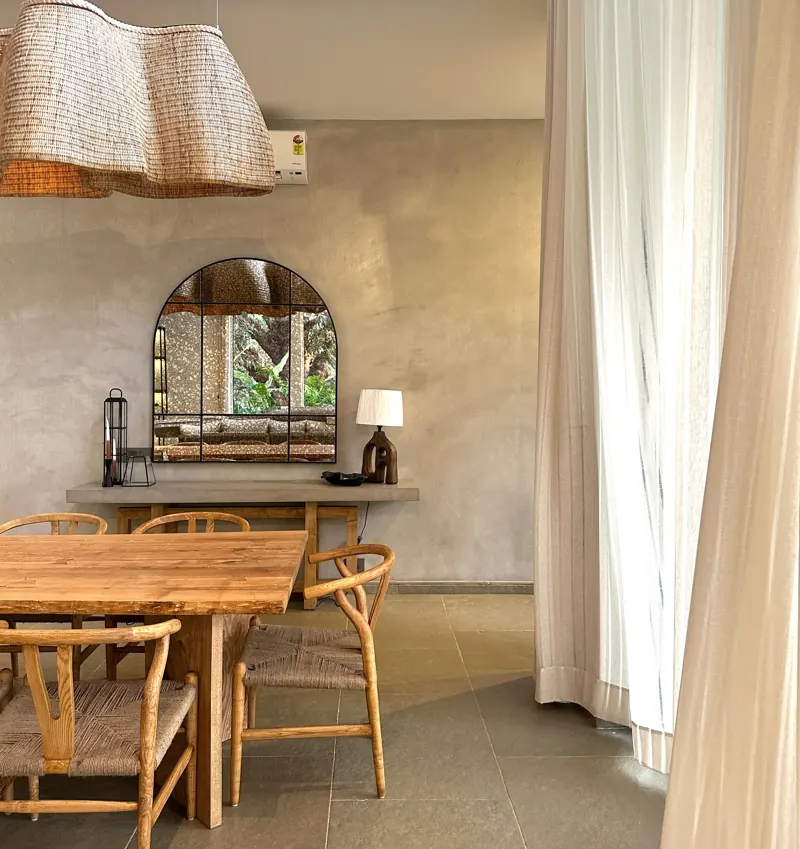
Use a warmer-toned floor alongside timber, natural textiles, lime-based walls, and softer lighting, and the same broad material category can contribute to a very different interior atmosphere.
The best micro cement floor finish should therefore be selected as part of the complete material palette—not in isolation.
Is Micro Cement Flooring Durable?
Micro cement flooring can provide a durable decorative surface when the appropriate system is specified and professionally applied over a suitable substrate. However, durability should not be treated as an absolute property independent of the project.
Several factors influence long-term performance:
- substrate condition
- preparation quality
- application system
- protective treatment
- expected traffic
- environmental conditions
- ongoing maintenance
A floor in a private bedroom does not experience the same use as the entrance to a busy retail environment. Likewise, a properly prepared stable substrate presents a different starting condition from a floor with unresolved movement or moisture problems.
This is why asking simply:
“Is micro cement durable?”
doesn't tell the whole story.
A better question is:
“Is the proposed micro cement system appropriate for the way this particular floor will be used?”
That question encourages the architect, applicator, and client to consider the entire flooring system rather than evaluating the decorative layer in isolation.
What About Scratches and Everyday Wear?
No decorative floor should be assumed to be completely immune to wear.
Furniture movement, abrasive dirt, heavy objects, traffic patterns, cleaning methods, and the nature of use can all affect a finished surface over time.
The appropriate protective system and maintenance routine therefore matter, particularly in commercial environments.
For residential interiors, simple behavioural measures—such as avoiding unnecessarily abrasive cleaning methods and protecting floors from damaging furniture movement—can also contribute to maintaining the appearance of the finish.
The goal should not be to promise an indestructible floor.
It should be to select and maintain the surface according to its intended environment.
Does Micro Cement Flooring Crack?
This is one of the most important questions prospective buyers ask, and it deserves a more careful answer than a simple “yes” or “no.”
A properly specified and professionally applied micro cement system is designed to create a durable decorative surface. However, the possibility of cracking cannot be discussed without considering what is happening underneath the finish.
Micro cement is not a structural floor slab.
If the underlying substrate experiences significant movement, develops structural cracks, contains unresolved joints, or has other stability problems, those conditions can potentially influence the decorative surface above.
This is another reason substrate inspection and preparation are fundamental parts of micro cement application.
Rather than choosing a product based on an absolute “crack-proof” promise, buyers should ask how the existing substrate will be assessed, how cracks and joints will be handled, and what preparation system is proposed before the finish is applied.
That conversation provides far more useful information about the likely quality of the project.
Is Micro Cement Flooring Suitable for Bathrooms and Wet Areas?
Micro cement is widely considered for contemporary bathrooms because a continuous surface can create a clean, visually cohesive appearance across selected floors and walls.
But a bathroom introduces requirements that do not exist in every dry interior.
Water exposure, drainage, junctions, substrate preparation, waterproofing strategy, slip considerations, and the protective system all become important.
For that reason, it is better to think about a complete bathroom surface system rather than assuming the decorative micro cement layer alone makes every application automatically suitable for water exposure.
Waterproofing and Micro Cement Are Not the Same Thing
This distinction is especially important.
The decorative finish visible at the end of the project is only one part of the build-up. Where waterproofing is required, it should be properly addressed within the specified system rather than relying on a broad assumption that “micro cement is waterproof.”
Similarly, the protective treatment used with the decorative finish needs to be suitable for its intended environment.
For homeowners, this may sound more technical than simply selecting a bathroom tile. But understanding the distinction can prevent unrealistic expectations.
Drainage and Detailing Matter
In bathroom floors and shower areas, the surface needs to work with the project's drainage and detailing requirements.
Falls towards drains, junctions between surfaces, corners, penetrations, and transitions should therefore be considered as part of the project before application begins.
This is one area where collaboration between the designer, contractor, waterproofing team, and specialist surface applicator can be particularly valuable.
Don't Choose a Bathroom Finish From Appearance Alone
A beautiful seamless bathroom photograph can provide design inspiration, but it cannot show:
- the substrate underneath
- waterproofing details
- drainage
- surface preparation
- protective layers
- workmanship involved in producing the finished space
For this reason, homeowners and designers considering micro cement flooring for bathrooms should evaluate both sides of the decision:
the aesthetic result they want and the technical conditions required to achieve it successfully.
That principle applies beyond bathrooms as well.
With specialist architectural finishes, what happens before the visible final layer is often just as important as the finish itself.
How Do You Maintain Micro Cement Flooring?
One of the advantages of a continuous floor is that there are no conventional grout lines dividing the surface into individual tiles. This can make routine cleaning relatively straightforward. However, micro cement flooring still requires appropriate care, and its maintenance should be considered before the material is selected.
The exact recommendations will depend on the micro cement system and protective finish used. As a general principle, regular cleaning should be gentle rather than aggressive.
Dust, grit, and other abrasive particles should not be allowed to accumulate unnecessarily, particularly in high-traffic areas where they can be carried across the floor under footwear. Routine sweeping, vacuuming, or suitable damp cleaning can help maintain the surface.
Harsh chemicals or highly abrasive cleaning methods should not automatically be used simply because the floor has a cementitious appearance. The protective finish is an important part of the installed system, so cleaning products and methods should be compatible with it.
Spills should also be dealt with reasonably promptly rather than being left on the surface for extended periods.
In commercial environments such as cafés, retail stores, offices, or hospitality spaces, maintenance planning should ideally happen before the floor is specified. The cleaning team needs to understand what products and methods are appropriate for the finish.
Depending on the system, level of use, and condition of the protective layer, periodic professional assessment or renewal of the protective treatment may also be appropriate over the life of the floor.
The key point is simple: a low-joint surface may be easier to keep visually clean than grout-heavy flooring, but low maintenance should never be interpreted as no maintenance.
What Are the Limitations of Micro Cement Flooring?
Understanding the advantages of a material is useful. Understanding its limitations is what helps someone make a better specification decision.
Micro cement can be an excellent choice for the right project, but it should not be presented as a universal replacement for every flooring material.
Application Quality Has a Major Influence on the Result
Micro cement is a specialist applied finish.
Unlike a factory-manufactured tile that arrives as a finished unit, much of the final character of a micro cement floor is created on site. Surface preparation, application technique, layer build-up, finishing, and protection all contribute to the result.
This makes workmanship particularly important.
Two projects using a similar colour can still look and perform differently if the substrate conditions and quality of execution are different.
For clients, this means choosing a micro cement floor should involve evaluating not only the material but also the expertise behind its application.
Existing Substrate Problems Cannot Simply Be Covered Up
Renovation potential is one of micro cement's attractions, but it should not become an excuse to ignore the existing floor.
Loose tiles, active movement, significant cracks, moisture-related problems, or an unsuitable substrate need to be properly evaluated.
Covering a problematic surface does not necessarily eliminate the problem underneath.
This is why a site assessment can be more valuable than selecting a finish from photographs and immediately scheduling application.
Hand-Applied Does Not Mean Factory-Uniform
For some clients, this is an advantage. For others, it can be an unexpected characteristic.
Micro cement can show subtle tonal and textural variation associated with the material and its application. If someone expects every square metre to look exactly identical, the visual character of an artisanal surface should be discussed before the project is approved.
Physical samples help establish expectations, but even a sample is a representation of a handcrafted finish rather than a guarantee that a large floor will reproduce every mark identically.
This natural variation can be precisely what gives the finished surface depth and individuality.
Repairs Require Consideration
Damage to any continuous decorative surface can create a different repair challenge from replacing an individual modular tile.
The appropriate repair approach depends on the type and extent of damage, the finish, age of the surface, and the surrounding area. Because the floor can contain tonal variation, making a local intervention visually unobtrusive may require specialist assessment.
This does not mean continuous flooring cannot be repaired. It means repair expectations should be realistic and system-specific.
Micro Cement Is Not Automatically Right for Every Site
A material may look perfect on a mood board and still be unsuitable for particular project conditions.
Substrate stability, moisture, traffic, exposure, programme constraints, expected maintenance, and application conditions all need to be considered.
A responsible specification process sometimes results in recommending a different surface system.
That is better than forcing a material into an application simply because the client likes its appearance.
Micro Cement Flooring vs Other Flooring Options
Micro cement is often compared with tiles, marble, polished concrete, and resin-based seamless flooring because these materials can compete for similar projects. However, they should not be treated as interchangeable.
The right choice depends on what the project is trying to achieve.
Micro Cement vs Tiles
The most immediately visible difference is modularity.
Tiles create a floor from individual pieces and normally introduce joints and grout lines. Micro cement creates a more continuous-looking surface without conventional tile joints across the field of the finish.
Tiles offer enormous variety in dimensions, patterns, materials, and factory-produced appearances. They can also make local replacement comparatively straightforward where matching units remain available.
Micro cement, on the other hand, becomes particularly attractive when the design calls for visual continuity, a mineral character, and fewer interruptions across the floor.
In renovation projects, the condition of existing tiles may also determine whether they can potentially form part of the substrate preparation strategy rather than being removed.
Neither is universally better. They produce different architectural results.
Micro Cement vs Marble
Marble brings natural veining, geological character, and the individuality of natural stone. Micro cement creates a much more continuous and understated visual language.
A designer looking for the richness and variation of natural stone may prefer marble. A project seeking a restrained surface that visually connects a larger area may favour micro cement.
Installation systems, joints, maintenance expectations, repair considerations, and the character of the finished surface also differ.
The decision should therefore begin with design intent and project conditions, not with an attempt to declare one material superior.
Micro Cement vs Polished Concrete
The two can sometimes appear similar in photographs, particularly when grey mineral finishes are involved, but their construction is fundamentally different.
Polished concrete involves working with a concrete floor itself, whereas micro cement is a comparatively thin decorative system installed over an appropriate substrate.
That difference influences renovation possibilities, floor build-up, application, detailing, and the overall specification process.
Projects seeking a concrete-inspired appearance should therefore establish whether they actually require a structural/polished concrete floor or a decorative micro cement surface.
Micro Cement vs Epoxy Flooring
Both can create floors with relatively continuous visual surfaces, but their material character and typical design expression can be quite different.
Micro cement is generally selected when the desired aesthetic is mineral, tactile, or concrete-inspired. Epoxy and other resin systems can produce a different surface character and are often specified according to their own performance and application requirements.
Rather than grouping every seamless floor together, designers should consider the visual objective, environment, traffic, maintenance, substrate, and required system performance.
As Colortale's content library expands, these individual comparisons can be explored in greater technical depth without overloading one guide.
What Should You Check Before Choosing Micro Cement Flooring?
Before finalising micro cement, a buyer or project team should be able to answer a few fundamental questions.
First, what is the existing substrate? Its stability, condition, cracks, joints, moisture, and previous finishes may influence the preparation required.
Second, where will the flooring be used? A bedroom, bathroom, luxury residence, restaurant, retail store, and high-traffic commercial space do not impose identical requirements.
Third, what level of traffic and wear is expected? The surface system should be selected with real use in mind rather than appearance alone.
Fourth, will the area experience regular moisture or water exposure? Wet environments require additional consideration of the complete system, detailing, and substrate.
Fifth, what should the floor actually look like? Colour is only one variable. Texture, tonal movement, sheen, and the relationship with surrounding materials matter too.
Sixth, how much handcrafted variation is acceptable? A client expecting absolute factory uniformity should discuss that expectation before approving an artisanal finish.
Seventh, what maintenance will the space realistically receive? Residential and commercial maintenance routines can be very different.
Eighth, who will execute the application? Specialist decorative finishes depend heavily on substrate preparation and workmanship.
Ninth, has a physical sample been reviewed? Digital images are valuable for inspiration but cannot fully communicate surface texture, subtle colour movement, or how a finish reacts to light.
Finally, are the site conditions ready for application? Material selection should be coordinated with the actual construction programme rather than treated as an isolated decorative decision.
These questions provide a far better basis for choosing micro cement flooring than simply asking whether the material is currently popular.
Choosing Micro Cement Flooring for Indian Projects
For projects in India, the same fundamental specification principles apply, but local site conditions make professional assessment particularly important.
India does not have one universal climate or construction environment. Conditions can vary considerably between cities, seasons, buildings, and even different areas within the same project.
A renovation in Delhi NCR, a hospitality project in Goa, an apartment in Mumbai, and a commercial interior in Bengaluru may present different substrates, moisture conditions, construction schedules, and usage requirements.
For this reason, choosing micro cement flooring in India should not rely on generic assumptions about how the material will behave everywhere.
The actual project needs to be evaluated.
New Construction vs Renovation
New-build projects provide an opportunity to coordinate the surface finish with the wider construction sequence from an earlier stage.
Renovations present a different set of questions.
What flooring already exists? Is removal necessary? Are existing tiles firmly bonded? Is the floor level? Are there cracks or moisture concerns? How will the new finish meet doors, skirting, adjoining rooms, or other flooring materials?
Answering these questions early can make specification and execution much more predictable.
Residential vs Commercial Requirements
A premium residence may prioritise seamlessness, tactile character, colour, and integration with the overall interior palette.
A commercial environment may add further considerations around traffic, cleaning schedules, operating hours, construction timelines, and coordination with other contractors.
The material name may be the same, but the specification process should respond to how the project will actually function.
That is particularly important for architects and designers evaluating micro cement across multiple project types.
Why Physical Samples Matter Before Finalising a Micro Cement Floor
Online photographs are useful for discovering ideas. They are not enough to fully evaluate a handcrafted architectural finish.
A photograph is influenced by camera settings, editing, screen calibration, lighting, and the environment in which the surface was photographed. It also cannot communicate how the material actually feels.
A physical sample allows architects, interior designers, and homeowners to assess the finish more realistically.
It can help evaluate:
- texture
- tonal movement
- approximate colour direction
- surface character
- relationship with other materials
- behaviour under different lighting conditions
Ideally, the sample should be viewed alongside the project's actual material palette.
Place it near the timber, stone, fabrics, metal finishes, cabinetry, or wall colours being considered. View it under daylight and the artificial lighting planned for the space where possible.
A surface that appears cool and understated under one light source may read differently under another.
For larger or particularly design-sensitive projects, the specification team may also need to discuss whether a larger sample or mock-up is appropriate.
Colortale offers customisable surface finishes and works with clients across different project requirements. For anyone considering Micro Cement, contacting the team to review physical samples and discuss the intended application can help establish clearer expectations before the final finish is selected.
Is Micro Cement Flooring Right for Your Project?
Micro cement flooring is worth considering when a project calls for a seamless visual language, contemporary mineral character, customisable colour and texture, and continuity across interior surfaces.
It can work across residential, retail, office, and hospitality environments, and its ability to work with suitable existing substrates can make it particularly interesting for certain renovation projects.
But the finished appearance is only half the decision.
A successful micro cement floor also depends on the condition of the substrate, appropriate preparation, the complete specified system, environmental and usage conditions, skilled application, and realistic maintenance expectations.
That is why the best question is not simply:
“Should I choose micro cement flooring?”
It is:
“Is micro cement the right surface system for this particular space, substrate, design intent, and way of using the floor?”
When those factors align, micro cement can become more than a flooring treatment. It can act as a continuous architectural surface that helps bring the wider interior together.
For projects considering Micro Cement, Colortale can support material and finish selection, physical sample evaluation, application requirements, and project-specific surface discussions before execution begins.